
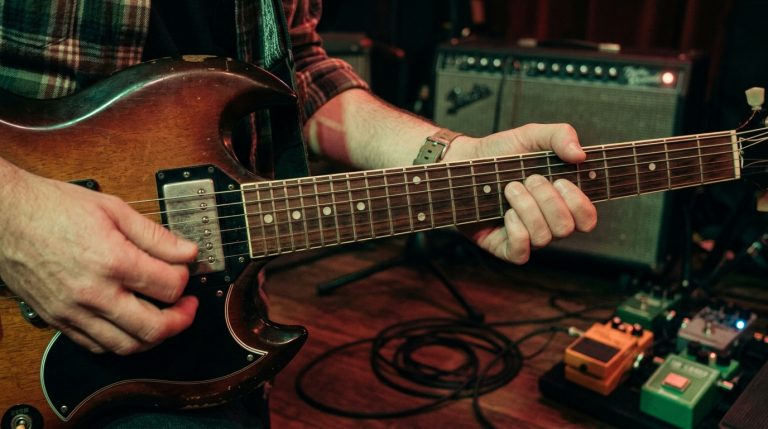
A 16th-note R&B groove sounds effortless when a great player locks in. However, most rock guitarists hit the same wall: the rhythm falls apart the moment they overthink the picking hand. You tense up, the motion stops between chords, and suddenly the groove sounds choppy and stiff.
This article solves that specific problem. You will learn why the picking hand must stay in constant motion, how forearm rotation creates that loose R&B feel. How percussive fret-hand mutes fill the spaces that make the groove breathe. If you are just beginning this journey, start with the full roadmap for rock players crossing into R&B territory before diving into the mechanics below.
Why Your 16th-Note Motion Keeps Falling Apart
The single biggest mistake rock players make is treating the picking hand like a tool they deploy only when a chord lands. In rock, that works fine. In a 16th-note R&B groove, stopping the hand between hits kills the subdivision. The body loses track of where “e” and “a” live inside every beat.
Think of the picking hand as a metronome attached to your forearm. It swings down and up, down and up, constantly. Some strokes strike the strings. Others pass through the air. Both motions matter equally, because both maintain the physical clock.
Once you accept that the hand never stops, everything else becomes easier to feel and easier to time.
16th-Note Grooves: Forearm Rotation Is the Engine
Here is where most players go wrong with the physical mechanics. They swing the whole arm parallel to the body, like wiping a table. That motion is slow and tiring. Instead, rotate the forearm, the same motion you use to turn a door handle.
With forearm rotation, the pick travels in a tight arc over the treble strings. On the downstroke, the pick attacks the strings with authority. On the upstroke, it brushes across them lightly. As a result, you get a natural dynamic contrast built right into the motion, which is exactly what R&B rhythm guitar needs.
A loose forearm also makes percussive mutes possible. Specifically, when the fret hand releases between chords, the picking hand continues its arc and strikes muted strings cleanly. Without that loose arm rotation, the timing of those muted clicks becomes impossible to place accurately.
16th-Note Grooves: Percussive Clicks Fill the Spaces Between Chords
This is the mechanic that separates a real groove from a strummed rhythm part. Between chord shapes, release the fret hand so the strings go dead. However, do not stop the picking hand. Let it continue its arc and strike those muted strings, producing a dry percussive click.
Those clicks are not mistakes. In fact, they are the rhythm. They fill the 16th-note subdivisions that would otherwise be empty. They push the groove forward the same way a snare or clap does in the drum track.
For example, try playing a simple two-chord vamp and consciously release the fret hand a fraction of a beat early on every chord change. The click lands right in the grid. That tiny gap becomes a rhythmic event instead of dead space. The role of single-note muted figures in a real groove builds directly on this idea, so check that article when you are ready to take the concept further.
Start With One Chord and Count Out Loud
Before you worry about chord changes, isolate the right-hand motion. Fret an F Major 7 and hold it. Now start the continuous down-up forearm rotation and count “1-e-and-a, 2-e-and-a” out loud. Do not stop counting and do not stop moving.
First, strum only on beat 1 and let the rest of the strokes pass through the air. Then, gradually add more hits on specific subdivisions while the motion stays constant. Because you are counting out loud, you will hear exactly where each hit lands inside the bar.
This drill feels mechanical at first. However, after five minutes, the motion becomes automatic. Once it is automatic, you can redirect your attention to chord shapes, voicings, and feel. Additionally, saying the subdivision out loud trains your ear and your body at the same time, which is faster than a metronome alone.
Seventh chord voicings that sit perfectly inside this kind of groove are worth exploring once the right-hand motion is locked, because the chord shapes you choose will affect how the muted clicks ring.
Tension Is the Enemy of Pocket
Grip pressure is everything. A tight, white-knuckle grip stiffens the forearm and slows the rotation. As a result, the arc shortens, the mutes get muddy, and the upstrokes lose their lightness.
Hold the pick firmly enough that it does not fly out of your hand. Beyond that, stay loose. Imagine the pick is a paint brush making quick, light contact with the strings on every upstroke.
Also, watch your elbow. If it drifts away from the body, the rotation point shifts and the arc widens too much. Keep the elbow close and let the forearm do the work. In contrast, a rock picking motion often uses the whole arm. That habit will work against you here, so retrain it deliberately.
16th-Note Grooves: Putting the Full Groove Together
Once the motion is automatic and the clicks are landing cleanly, start building the full picture. Add a simple chord progression, something like F Major 7 to B-flat Major 7. Keep the tempo slow, around 65 BPM. Then gradually introduce rhythmic accents on the “and” of beat 2 and beat 4, which is where R&B rhythm guitar lives.
From there, explore hybrid picking approaches used in classic Marvin Gaye rhythm parts and how melodic thirds and sixths sit on top of this kind of groove. Both of those ideas plug directly into the physical foundation you are building here.
Most importantly, record yourself. Playback reveals hesitations and stop-and-start motion that you cannot feel in real time. A ten-second clip tells you more than ten minutes of playing without listening.
For the bigger picture of how all these R&B skills connect and what they give your rock playing in return, revisit the full guide to why R&B guitar makes rock players better. The groove you build here will show up in everything you play.
Learn guitar and get personalized coaching from Dave Isaacs at ArtistWorks!Start →
Featured Contributor
A Nashville guitarist, songwriter, and veteran music educator, he’s known for teaching musicianship, confidence, and practical guitar skills. He performs across rock, blues, country, jazz, and folk styles, and is a Manhattan School of Music graduate and former university music instructor.