
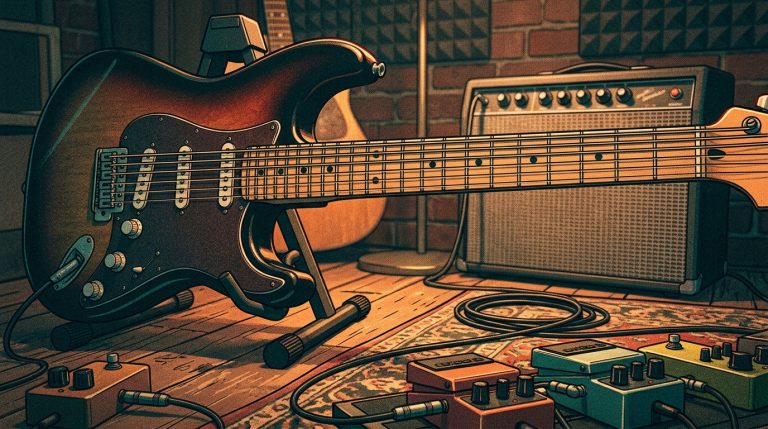
R&B guitar sits right next to rock on the family tree, yet the feel is completely different. Both styles use the same six strings, the same amps, often the same pentatonic scale. However, a handful of specific techniques separate a rock guitarist from someone who can truly play R&B. Learning those techniques does not just add a new style to your toolkit. It rewires the way you think about groove, touch, and harmony, and those changes will show up every time you plug in, no matter what you are playing.
This article gives you a practical roadmap for crossing that bridge. It is built around five core skills that instructor Dave Isaacs uses to teach authentic R&B guitar: seventh-chord vocabulary, 16th-note strumming mechanics, muted single-note figures, parallel thirds and sixths, and syncopated hybrid picking. Each section gives you the big picture of why that skill matters. Then it points you to a deeper guide where you can really dig in.
By the end, you will understand exactly what makes R&B guitar feel the way it does. You will have a clear path to developing that feel yourself.
Why R&B Guitar Feels So Different from Rock
Rock guitar tends to reward attack. Big bends, high gain, aggressive picking strokes. R&B guitar, however, rewards restraint. The tone is cleaner. The touch is lighter. The groove is steadier.
That contrast is the first thing most rock players notice. You do not stop playing hard in R&B. Instead, you play with intention. Every stroke, every muted click, every sliding chord has a specific job in the rhythm. As a result, the music locks together in a different way than a rock riff does.
The second big difference is harmonic. Rock leans on power chords and pentatonic runs. R&B, on the other hand, loves extensions: major sevenths, minor sevenths, ninths, the stacked “church chord” that gives gospel-influenced soul its signature color. Those sounds are not difficult to play. For many rock guitarists, though, they feel unfamiliar at first because the genre rarely calls for them.
Learn guitar with Dave Isaacs at ArtistWorks – Try a FREE 7 day trial!Start →
Seventh Chords and Extensions: The Harmonic Foundation of R&B Guitar
The most immediate way to sound more R&B is to swap out your open chords and barre chords for their seventh-chord equivalents. A simple C major becomes a Cmaj7. An Am becomes an Am7. These substitutions cost you almost nothing technically, but they shift the emotional weight of the music dramatically.
The so-called “church chord,” built by playing a major chord shape over a whole step below its root (for example, a B-flat chord over C), is a specific sound you will recognize the moment you hear it. It shows up constantly in classic soul and contemporary R&B. In addition, dominant seventh chords and ninth voicings add the tension and release that makes an R&B progression breathe.
For rock players, this harmonic shift is genuinely exciting. You are not replacing what you already know. You are layering new color on top of it. Get into the details of these voicings and how to use them in context. You will hear the difference in your playing immediately.
16th-Note Strumming: The Engine Behind Every R&B Guitar Groove
Rhythm is where most rock guitarists find R&B most challenging. Not because the patterns are complicated, but because they require a different physical approach. The key is a relaxed, rotating forearm motion that keeps the picking hand in near-constant motion, down and up, whether or not the pick touches the strings on every stroke.
Think of it like a metronome that lives in your arm. The hand keeps moving at 16th-note speed. Your chord hits and muted strokes land at specific points inside that motion. As a result, the groove stays even and relaxed instead of lurching forward on each downbeat the way rock rhythm parts sometimes do.
For rock players used to aggressive downstroke riffing, this feels strange at first. However, even a week of slow practice with this technique will change your internal sense of rhythm in ways that carry over to every style you play. The subdivision awareness alone is worth the work. Learn how to build and control that 16th-note strumming motion with the right arm mechanics and posture.
Check out the Session Players Toolkit with Dave Isaacs at ArtistWorksStart →
Muted Single-Note Figures: Adding Percussion to Your R&B Guitar Parts
R&B rhythm guitar is not just about chords. Between the chord hits, you will often hear short, clipped, palm-muted single-note figures running across the treble strings. These figures act as a second percussion layer. They punch through a full band mix and hold the groove together even when the drummer is playing sparse patterns.
Technically, these figures combine light palm muting with precise picking on the higher strings. The muting softens the attack and shortens the note length. The result is a sound somewhere between a guitar note and a snare click.
For rock players, the palm mute is already familiar. However, in rock it is usually applied to the low strings for power-chord chugging. Moving that technique to the treble strings and integrating it into a rhythmic figure between chord stabs is a different skill. See exactly how these muted treble figures are built and practiced so you can start weaving them into your own grooves.
Parallel Thirds and Sixths: The Melodic Sweetness of Classic R&B Guitar
You have heard this sound on hundreds of records without necessarily knowing what it was. Two notes moving in parallel, sliding smoothly up the high strings, sitting just above the rhythm groove. That is the parallel thirds and sixths technique. It is one of the most recognizable sounds in r&b guitar.
The concept is straightforward. You play two strings simultaneously, keeping the same interval relationship as you slide or shift up the neck. Major thirds give you a bright, hopeful sound. Sixths, especially on the B and G strings, have a warmer, slightly sweeter quality. Both intervals appear constantly in classic Stax and Motown recordings.
Rock players already use double stops occasionally. However, using them in a sliding, melodic, interval-specific way takes some focused practice. The shapes themselves are compact and easy to memorize. The real work is in the smoothness of the slides and the lightness of the touch. Dig into how to find and use these interval shapes on the high strings for a complete breakdown.
Syncopated Hybrid Picking: Locking In the Upbeat Feel
This is the technique that ties everything together. Hybrid picking means using both the pick and your bare fingers at the same time. In r&b guitar, it gives you the ability to simultaneously pluck upbeat chord stabs with your fingers while keeping a steady pick stroke going through the groove.
The upbeat emphasis is crucial. Much of what makes R&B feel like R&B is the way accents land on the “and” of beats rather than on the downbeats themselves. When you can reliably hit those upbeats with clean, confident finger-plucked chord stabs, the groove suddenly comes alive in a new way.
Rock players typically rely on a pure pick technique. Therefore, adding finger independence on top of a pick stroke requires some rewiring. Start slowly. Focus on getting the upbeat plucks clean before adding speed. The payoff is enormous. This technique makes your playing feel rhythmically intentional in a way that straight picking simply cannot achieve. Follow the detailed breakdown of hybrid picking rhythms in a classic soul style to develop the coordination this technique requires.
The Rock Guitarist’s Secret Advantage
Here is something worth noting: rock players actually come to R&B with real strengths. You likely have good pick control, solid left-hand strength, and a trained ear for guitar tone. Those assets transfer directly.
The adjustments are mostly about subtraction. You are learning to do less, touch lighter, and let the groove breathe. For many rock guitarists, that shift feels like a revelation. Suddenly you are hearing space in music differently. You are making deliberate choices about when not to play. As a result, your playing across every style becomes more musical.
Even a basic R&B vocabulary, just a few seventh voicings, a clean 16th-note strum, and one or two muted figures, will change how you hear rhythm. That change is permanent. It becomes part of how you listen to music and how you respond to it on the guitar.
Continue Learning
Every skill in this article has its own deeper guide. Work through them in this order for the most logical progression: start with harmony, build the strumming engine, add the muted figures, explore the melodic intervals. Finally lock in the hybrid picking feel.
- Build your R&B chord vocabulary from the ground up
- Master the 16th-note strumming technique that drives the groove
- Learn how muted treble figures add percussive depth to your rhythm parts
- Explore parallel thirds and sixths for that classic soulful melodic sound
- Develop syncopated hybrid picking rhythms in the style of classic Marvin Gaye recordings
Final Thought
R&B guitar is not a detour from your development as a rock player. It is a direct investment in it. The five skills mapped out here, specifically the harmonic color of seventh-chord extensions, the relaxed engine of 16th-note strumming, the percussive punch of muted figures, the melodic sweetness of sliding intervals, and the rhythmic precision of hybrid picking, will make every guitar part you play more intentional and more musical. Dave Isaacs built a complete course around exactly these skills, and TrueFire has it ready for you right now. If you have ever wanted your rhythm guitar to feel like it locks into a groove rather than just riding over it, this is where you start.
Learn guitar and get personalized coaching from Dave Isaacs at ArtistWorks!Start →
Featured Contributor
A Nashville guitarist, songwriter, and veteran music educator, he’s known for teaching musicianship, confidence, and practical guitar skills. He performs across rock, blues, country, jazz, and folk styles, and is a Manhattan School of Music graduate and former university music instructor.