
DI
Conscious listening practice sounds simple: put on a song, pay attention. But most guitarists skip it entirely. The moment they decide to learn something new, they grab the guitar and start hunting for the first chord. That instinct costs you more time than it saves. Dave Isaacs, a Nashville-based guitarist, songwriter, and educator, has built a five-step song-learning process that reorders your priorities in a way that actually works. This article focuses on the step that happens before your hands touch the instrument: building the song in your mind first. If you want the full picture of how the system fits together, start with the complete five-step breakdown and come back here for a deeper look at the listening foundation.
Why Most Players Start in the Wrong Place
The instinct to grab your guitar the second you hear a song you love is understandable. Playing feels productive. Listening feels passive. But that instinct flips the actual order of things.
When you start on the guitar before the song lives in your head, you are solving two problems at once. First, you are figuring out the structure and flow of the music. Second, you are trying to get your hands to execute it. That double burden is why so many players stall. It is also why so many land in a permanent loop of noodling through the same section without real progress.
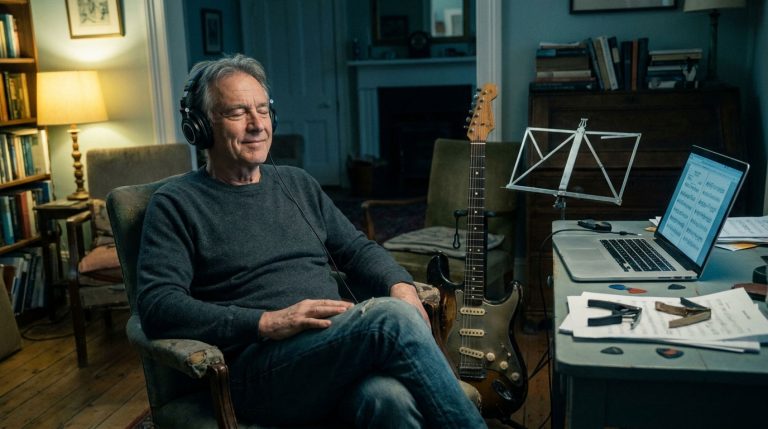
Conscious listening practice solves the first problem before the second one even begins. Once the song is genuinely mapped in your mind, you already know what is coming next. As a result, your hands have only one job: follow the music you already know.
The Goal Is a Song That Runs in Your Head
Dave Isaacs puts it plainly. “I think the main thing is that you want to actually know the song well enough that it’s basically playing in your head and you’re following along.”, Dave Isaacs
That phrase, “following along,” is doing a lot of work. It means you are not piecing the song together in real time. Instead, the music is already unfolding in your mind. Your hands are simply tracking it. Think of it like reading text aloud. A fluent reader does not decode each letter. They process meaning, and the speaking follows automatically. In the same way, when conscious listening practice has done its job, your guitar playing becomes the output of something you already know. It stops being the process of figuring it out.
Get direct video feedback on your playing from Dave Isaacs at ArtistWorksStart →
What Conscious Listening Practice Is Actually Listening For
Listening this carefully is not the same as enjoying a song. You are building a mental model. Here is what to target during your conscious listening practice sessions.
Sections. Identify the distinct parts: intro, verse, chorus, bridge, outro. Notice how many times each appears and in what order. Can you hum each section back without the recording?
Transitions. These are the seams where one section moves into the next. Transitions are where most players get lost on stage. They have practiced sections in isolation. They never internalized the connective tissue between them.
Energy arc. Notice how the song builds and releases tension over its full length. Where does it peak? Where does it pull back? That arc shapes how you phrase and how hard you dig in at any given moment.
The groove and feel. Before you touch the guitar, you should be able to tap the pulse and feel where the beat sits. Notice whether the rhythm leans forward or settles back. That internal feel is what connects your playing to the music later.
If you cannot hum every section from memory, including the transitions, your conscious listening practice is not finished. That is not a criticism. It is simply the checkpoint that tells you where to keep going.
The Steps Most Players Skip
Dave is direct about where the process tends to break down. “That initial stage, steps one and two are the things that most or at least many people seem to ignore.”, Dave Isaacs
He credits these early steps, the listening and mental mapping work that happens before the guitar even comes out, with providing the biggest boost to his own confidence and readiness. And he applies this same approach whether he is learning a new song for himself or preparing to back another artist in a professional setting. The process scales because the underlying need is the same at every level: you have to know the music before you can play it well.
When you understand that Dave uses this approach on professional gigs, the case for slowing down becomes harder to dismiss. This is not a beginner workaround. It is a professional discipline. It also happens to be the thing most players skip.
For a closer look at what specifically to listen for and how to structure those early sessions, the dedicated listening guide in this series goes deeper on method.
Conscious Listening Practice: The One-Week Challenge
Here is a concrete way to put conscious listening practice to work. Pick one song you want to learn. Then follow this sequence.
Days one and two: Listen actively, multiple times per day. No guitar. Map the sections on paper or in your head. By the end of day two, you should be able to sketch the full song structure from memory.
Days three and four: Focus on transitions and feel. Tap along, hum along, and notice every moment where the song shifts direction. Practice singing or humming the melody and the chord movement out loud.
Day five: Test yourself. Put the recording on and follow along in your head. No sound, no guitar. If you get lost anywhere, that is your target. Go back and close the gap.
Days six and seven: Now pick up the guitar. You are not learning the song anymore. You are confirming what you already know.
The difference in how that guitar session feels is the whole point. Because the song is already in your head, you can focus on touch, tone, and feel. You stop scrambling to keep up.
For more on what to do once the guitar is in your hands, the first-pickup practice guide picks up exactly where this challenge ends. And if you hit a wall on a specific section, the problem-solving article in this series gives you a method for working through it.
A Process That Starts Before the Guitar
A process that begins before you pick up the instrument is not slower. In fact, it is the thing that makes everything following it faster and more reliable. When you arrive at the guitar already knowing the song, you stop wasting time relearning the same bars in circles. You start building a real performance from the first session.
That shift, from surviving a song to shaping it, is what Dave Isaacs’ process is designed to produce. Conscious listening practice is where that shift begins. The full five-step framework gives you the complete roadmap. This is the step most players leave out. It is also the one that changes everything downstream.
Learn guitar with Dave Isaacs at ArtistWorksStart →
Learn guitar with Dave Isaacs at ArtistWorks
Continue Learning
Explore the rest of this series:
- How to Approach New Songs: Dave Isaacs’ 5-Step Guitar Process
- Should You Listen to a Song Before You Try to Play It? Yes — Here’s How
- How to Use a Chord Chart or Tab When Learning a Song (Without Picking Up the Guitar)
- How to Practice a New Song When You First Pick Up the Guitar
- Stuck on a Hard Part? How to Research and Solve Guitar Song Problems
- How to Memorize a Song on Guitar and Get It Performance-Ready
About the Education Team
Four music-industry veterans with decades of combined experience in music education, curation, and production at TrueFire and ArtistWorks. The TrueFire Studios Education Team plans and edits this content and works with our master-musician faculty to keep it accurate and genuinely useful.
Featured Contributor
DI
A Nashville guitarist, songwriter, and veteran music educator, he’s known for teaching musicianship, confidence, and practical guitar skills. He performs across rock, blues, country, jazz, and folk styles, and is a Manhattan School of Music graduate and former university music instructor.