
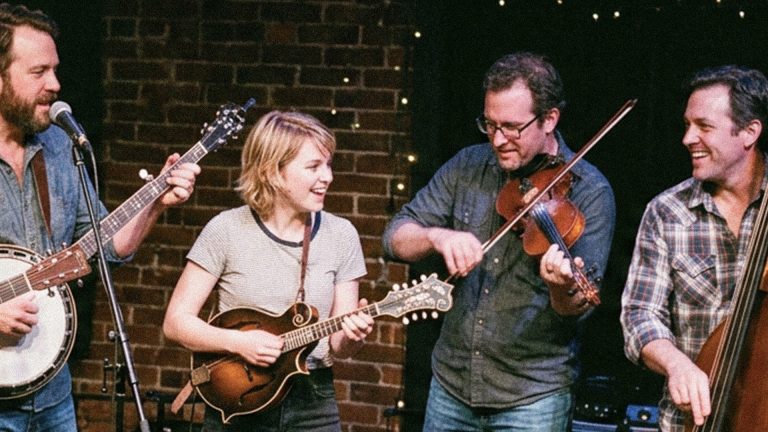
Bluegrass fiddle players have one advantage that no other instrument in the band can fully replicate: the bow. It lets you breathe, swell, cry, and whisper in ways that feel almost human. If you have ever watched a great fiddler take a break and thought, “that sounded like a person singing,” you were hearing something intentional. The fiddle’s closest musical relative is the voice, and the best bluegrass fiddlers know it.
This article is about leaning into that relationship on purpose. We will look at how bowing shapes feel, how ornaments add emotional pull. How leaving space between phrases can make your break more powerful than filling every beat. For the full picture of how every instrument fits into the ensemble conversation, start with the complete player’s guide to bluegrass improvisation.
The Bluegrass Fiddle and the Human Voice
The fiddle sits closest to the human vocal range of any instrument in the band. That is not a coincidence. Early American fiddlers heard singers and tried to match them, so the tradition built up a vocabulary of bends, swells, and cries that mirror how a voice moves through a melody.
When you approach your break, try humming the melody first. Notice where you naturally breathe, where you hold a note for emphasis, and where the phrase falls into a natural rest. Those instincts are your roadmap. In fact, many veteran fiddlers say that if you cannot hum the break, you cannot play it.
This singer’s mindset separates bluegrass fiddle from other styles. It is less about running scales and more about telling a short story in eight or sixteen bars.
Bowing Is the Source of Everything
Your bow hand is your rhythm section, your dynamics department, and your emotional engine all at once. Most beginners focus almost entirely on left-hand fingering, and their breaks sound mechanical as a result. However, the bow is where bluegrass fiddle truly lives.
A short, punchy bow stroke pushes the tune forward. A long, slow draw gives a note weight and presence. For example, landing on the root of a chord with a firm, slightly accented bow stroke makes the whole phrase feel resolved. Meanwhile, a light, fast bow on a passing note tells the listener to keep moving.
Practice varying your bow speed and pressure on a single open string before adding any fingers. Once you feel how much control you have, the rest of the technique starts to make sense.
Learn with IBMA Distinguished Achievement Award winner Darol Anger at ArtistWorksStart →
Slides, Double Stops, and the Bluegrass Cry
If bowing is the engine, then ornaments are the personality. Three tools in particular give bluegrass fiddle its emotional warmth: slides, double stops, and subtle vibrato.
A slide into a note mimics the way a singer approaches a pitch from below. Instead of landing cleanly on a note, you creep up to it. That small gesture adds ache and longing without any extra complexity. Similarly, a slide off the end of a phrase, just a brief drop in pitch, feels like a voice trailing away.
Double stops are two strings played simultaneously. They thicken the sound and add a chordal richness that sits beautifully in the ensemble. Use them strategically, not on every note. A well-placed double stop on a chord tone at the peak of a phrase can lift the whole break.
Vibrato on long tones is the final layer. Keep it subtle and use it selectively. A note that sustains without vibrato, then blooms into it, communicates more than vibrato applied to everything.
Space and Silence Make the Notes Hit Harder
This is the lesson most intermediate players skip. They want to fill the break from bar one to bar sixteen, afraid of leaving any empty air. However, a vocalist never does that, and neither should you.
Rests are rhythmic events. A deliberate silence after a strong phrase creates tension. Then, when you re-enter, the next note hits with twice the impact. Think of it as a call, then a breath, then an answer.
Start by identifying one or two natural resting points in the melody. Let the bow stop. Let the band breathe underneath you. You might feel exposed at first. The ensemble will actually sound more cohesive because you gave everyone room to be heard.
This connects closely to how other instruments manage space. For instance, how a banjo player finds the melody inside the roll involves a similar discipline of restraint. Meanwhile, the upright bass approach to tasteful support is built almost entirely around knowing when not to add notes.
Setting the Kick-Off and Backing Up the Singer
The fiddle often leads a tune off, and that moment carries real weight. Your kick-off sets the tempo, the feel, and the emotional temperature for everyone on stage. Play it too timid and the band comes in unsure. Play it too rushed and you lose the groove before it starts.
A good kick-off is deliberate and slightly stretched on the front end. Let the first couple of notes breathe. Give the band a clear pulse to lock into before the full group enters.
When you are backing up a singer or another lead instrument, your job shifts entirely. Long tones and shuffle rhythms are your tools here. Long tones cushion the melody without competing with it. A slow, sustained note on the fifth of the chord adds harmonic depth while the singer has room to move. Shuffle rhythms, meanwhile, keep the groove alive without demanding attention.
The goal in backup is to be felt rather than heard as a separate voice. Think of it as humming quietly behind someone who is telling a story. For more on how each instrument supports the others during breaks and backup, the ensemble improvisation guide maps out the full conversation.
From Thinking Vocal to Playing Vocal
The shift from a fiddle break that sounds competent to one that sounds like a vocalist is not about adding more notes. It is about committing to a phrase, following it through with the bow, and letting space do its work.
Start with one tune you already know. Hum it slowly and notice every breath. Then play it back, matching those breaths with bow lifts. Add one slide, one double stop, and let one rest land fully. Record yourself and compare it to how a singer delivers the same tune.
For more on how melody-first thinking applies across the band, how guitarists flatpick melody-first solos covers the same principle from a flatpicking angle. And if you are curious how the mandolin player pivots from chop to lead, that breakdown is worth a read too. The best bluegrass fiddle break is always a vocal performance. It just happens to use strings and a bow.
Start learning with ArtistWorksStart →
About the Education Team
Four music-industry veterans with decades of combined experience in music education, curation, and production at TrueFire and ArtistWorks. The TrueFire Studios Education Team plans and edits this content and works with our master-musician faculty to keep it accurate and genuinely useful.
ⓘWhere AI Assists, and Where the Team Decides
We use AI tools to help with research synthesis and first-draft generation, guided by team-written outlines and our editorial standards. Every article is then reviewed, fact-checked, edited, and approved by a member of our education team before publication. AI does not make publication decisions, and no article publishes under a TrueFire byline without team sign-off. We disclose AI use on every article that uses it — here at the bottom of the blog, where you can see it, not buried in a policy page.