
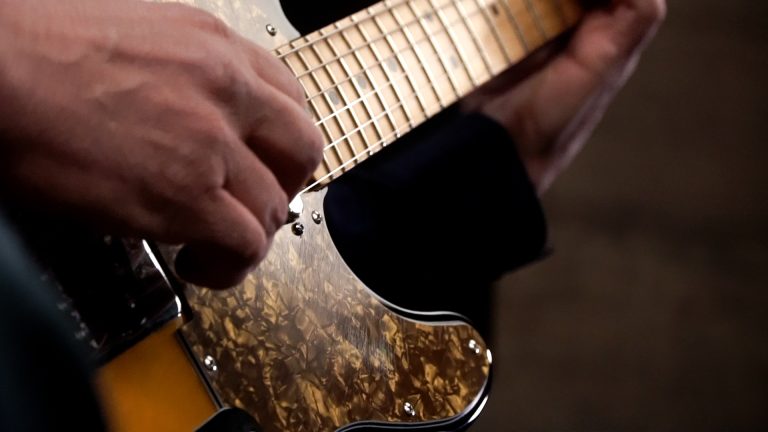
Hybrid picking is the secret weapon hiding inside some of the most iconic R&B guitar parts ever recorded. If you have come to R&B from a rock background, syncopated rhythms probably feel slippery at first. You are used to strumming through the beat, not landing precisely on the upbeats between it. That gap in feel is exactly what this article addresses.
We will break down how hybrid picking opens up rhythmic possibilities a flatpick alone cannot touch, use the guitar part from Marvin Gaye’s “What’s Going On” as a real-world map. Give you a counting framework that builds a physical, drummer-like sense of the 16th-note grid. For broader context on how this skill fits into your R&B vocabulary, start with the full R&B roadmap for rock guitarists.
Why Hybrid Picking Changes the Rhythmic Game
Most rock guitarists strum with a flatpick and rely on down-up motion to navigate rhythm. That motion is great for driving eighth-note grooves. However, it limits how independently you can voice different strings at different moments.
Hybrid picking solves this. The technique combines a flatpick on one string with the middle and ring fingers plucking other strings simultaneously. Because each string is covered by a different digit, you can assign each one a distinct rhythmic role. As a result, your bass string can anchor the downbeat while your fingers snap an upbeat on the inner strings at the exact same instant.
That independence is what gives classic Motown and soul guitar its texture. The parts sound fuller than a single pick line but more precise than a full strum. In short, hybrid picking lets one guitarist play rhythm and texture at the same time.
The “What’s Going On” Pattern Up Close
The guitar part on Marvin Gaye’s “What’s Going On” is a masterclass in restrained syncopation. The basic idea is simple: the pick handles the low string while the middle and ring fingers cover the 4th and 5th strings. However, the rhythmic placement is where everything gets interesting.
Instead of landing strings together on beats 1 and 3, the fingers frequently pluck on the “and” or the “a” of a beat. Those are the upbeats inside the 16th-note grid. For a rock guitarist, those spots feel like the floor drops out. You reach for a beat, and it is not there yet.
The pattern also uses silence aggressively. Many of the upbeats are followed immediately by a muted 16th. That mute is not an accident. It is a rhythmic event, just as deliberate as any note. Therefore, you cannot skip it when you are practicing.
Learn guitar with Dave Isaacs at ArtistWorks – Try a FREE 7 day trial!Start →
Counting the Full 16th-Note Grid Out Loud
This is the part most guitarists skip, and it is the reason the feel never arrives. You must count the complete 16th-note subdivision before you play a single note. Say “1-e-and-a, 2-e-and-a, 3-e-and-a, 4-e-and-a” out loud, at a slow tempo, until it becomes automatic.
Once you have that grid in your mouth, you know exactly where every possible rhythmic landing point lives. The “and” of 2 is no longer a vague space. It is a named address. For example, when the guitar part lands on the “a” of beat 3, you can feel it coming because you are counting toward it.
This approach comes directly from how drummers think. A drummer never loses the 16th-note grid, even when they are not playing on every subdivision. As a result, their placement is precise. Guitarists who adopt that same counting discipline find that syncopated patterns become dramatically easier to execute.
If 16th-note strumming is still new territory for you, the companion article on locking in your 16th-note groove feel is a great place to build that foundation first.
Hybrid Picking: Building the Hand Coordination on Open Strings
Here is the single most important practice step: run the hybrid picking motion on open strings before adding any chord shapes or syncopated patterns. This is not a warm-up. It is its own focused drill.
Set your metronome to 60 BPM. Pick the low E string with your flatpick on beat 1. Simultaneously pluck the G and B strings with your middle and ring fingers. Then mute everything on the “e” of beat 1. Next, pluck just the middle and ring fingers on the “and” of beat 1. Mute again on the “a.” Repeat this loop and count out loud the entire time.
Your pick hand will feel awkward at first. The middle and ring fingers may curl inconsistently, or they may not pluck with equal strength. However, open strings give you zero fretting pressure to manage, so you can focus entirely on the picking hand. Once the motion feels clean and consistent at 60 BPM, move to 70 and repeat.
For reference, your middle finger should curl slightly under the string and flick upward on the pluck. The ring finger follows the same motion. Neither should strum across multiple strings. Each one covers exactly one string, every time.
Check out the Session Players Toolkit with Dave Isaacs at ArtistWorksStart →
Adding Chord Voicings Without Losing the Rhythm
Once your hand coordination is solid on open strings, add a simple chord voicing. A Gmaj7 or Cmaj9 shape works well because they sit comfortably under the fingers. However, keep the rhythmic pattern exactly the same. Do not simplify it because you added a chord.
This is where rock guitarists often backslide. The fretting hand demands attention, and the picking hand loosens up. Suddenly the syncopation disappears and the part sounds like a strummed ballad. Therefore, be deliberate. Keep counting out loud even after you add the chord.
If you are building your R&B chord vocabulary alongside this, check out the guide on seventh chords and extensions for R&B guitar. Those voicings are exactly what Marvin Gaye’s guitar parts use underneath this kind of rhythmic texture.
Also worth exploring: muted single-note figures and parallel thirds and sixths both layer beautifully on top of a hybrid picking rhythmic foundation once you have it solid.
Hybrid Picking: Locking In the Feel Over Time
Hybrid picking is a physical skill before it is a musical one. Your fingers need repetitions before the motion becomes reflexive. First, drill the open-string pattern daily for at least a week. Then, apply it to one chord shape. After that, move the shape around the neck using the same pattern.
The goal is to reach the point where the picking hand runs on autopilot. Because once it does, your full musical attention shifts to feel, dynamics, and expression. That is when the part starts to sound like the record.
The R&B guitar roadmap maps out how hybrid picking fits alongside every other core skill you are building. The combination of groove, chord color, and rhythmic precision is what makes R&B guitar so rewarding to learn.
Learn guitar and get personalized coaching from Dave Isaacs at ArtistWorks!Start →
Featured Contributor
A Nashville guitarist, songwriter, and veteran music educator, he’s known for teaching musicianship, confidence, and practical guitar skills. He performs across rock, blues, country, jazz, and folk styles, and is a Manhattan School of Music graduate and former university music instructor.
ⓘWhere AI Assists, and Where the Team Decides
We use AI tools to help with research synthesis and first-draft generation, guided by team-written outlines and our editorial standards. Every article is then reviewed, fact-checked, edited, and approved by a member of our education team before publication. AI does not make publication decisions, and no article publishes under a TrueFire byline without team sign-off. We disclose AI use on every article that uses it — here at the bottom of the blog, where you can see it, not buried in a policy page.