
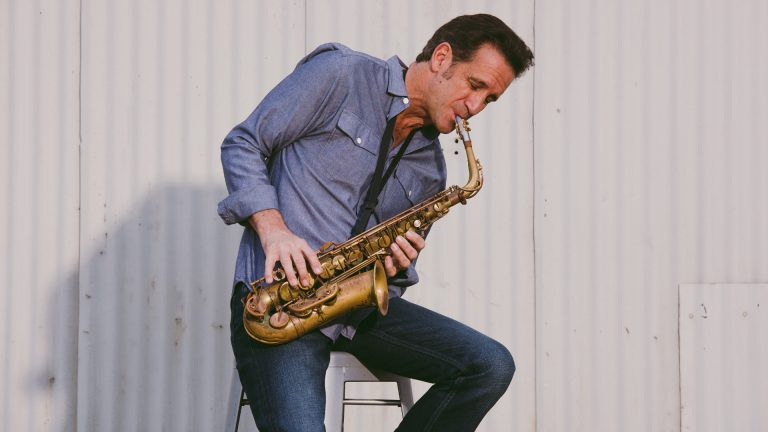
Jazz saxophone is one of the most expressive instruments in American music. From Charlie Parker’s velocity to Stan Getz’s warmth, John Coltrane’s harmonic depth to Cannonball Adderley’s bluesy swing, the saxophone has shaped the sound of jazz for decades.
If you’re just picking up the instrument or just starting to play jazz on a saxophone you already know, this guide will walk you through what you need: how to think about tone, which scales matter most, which standards to learn first, and how to structure your practice for steady progress. ArtistWorks’ sole jazz saxophone instructor, Grammy-winning saxophonist Eric Marienthal, will demonstrate the foundational tone-production exercise every beginner should drill regularly.
Table of Contents
- Why Jazz Saxophone Is Worth Learning
- Jazz Sax for Beginners: Where to Start
- Building Your Jazz Saxophone Tone
- How to Play Jazz Saxophone: Core Techniques
- Jazz Saxophone Scales Every Beginner Should Know
- Beginner-Friendly Jazz Standards to Learn First
- Building a Daily Practice Routine
- Study Jazz Saxophone with Eric Marienthal
Why Jazz Saxophone Is Worth Learning
The saxophone occupies a unique place in jazz. It’s a wind instrument that breathes in phrases like a singer, with a tonal range and emotional vocabulary that has shaped every era of the music. Bebop, cool jazz, hard bop, post-bop, fusion, and contemporary jazz all run through the saxophone in fundamental ways. Picking it up gives you access to a century of musical conversation, and the instrument itself rewards the time you put into it more than almost any other.
For an adult beginner, jazz saxophone is also one of the more achievable jazz instruments to start on. The basic note production is straightforward. The repertoire is well-documented. There’s a vast catalog of recordings to study. And the path from beginner to credible improviser, while demanding, is well-mapped by generations of teachers and players.
Jazz Sax for Beginners: Where to Start
Jazz sax for beginners starts with a single equipment question: which saxophone? The two most common jazz saxophones are the alto and the tenor. Both are essential to the tradition. The choice often comes down to size, sound preference, and which players inspire you most.
- Alto sax jazz. The alto is lighter and physically easier to handle, which makes it a common first instrument. It has a bright, agile sound. Charlie Parker, Cannonball Adderley, Paul Desmond, and Phil Woods are foundational alto voices. Eric Marienthal himself is widely known for his alto playing.
- Tenor sax jazz. The tenor is larger and produces a deeper, warmer tone. John Coltrane, Sonny Rollins, Dexter Gordon, Stan Getz, and Joshua Redman are core tenor voices. Many players find the tenor’s sound emotionally compelling, even though it’s a bit more physically demanding.
Beyond the sax itself, you’ll need a mouthpiece, reeds, a ligature, a neck strap or harness, and a music stand. Skip the cheapest no-name instruments. They’ll fight you constantly and undermine your progress.
Building Your Jazz Saxophone Tone
Tone is the saxophone’s currency. A great jazz saxophonist with a beautiful sound playing a simple phrase will move a listener more than a technical wizard with a thin or pinched tone playing something complicated. Building your tone starts on day one and continues for the rest of your playing life.
Three elements determine how much your reed vibrates, and how rich your sound is as a result:
- Embouchure. The shape of your mouth on the mouthpiece. Too much pressure chokes the reed. Too little pressure cushions it and dampens vibration. The bottom lip should rest firmly against the bottom teeth without being clenched.
- Throat. An open, relaxed throat lets air pass through freely. A tight throat strangles your sound.
- Diaphragm. Steady, supported breath from the diaphragm powers everything else. Shallow breathing produces shallow tone.
Eric Marienthal walks through a foundational embouchure exercise in the lesson above. The drill has you play a low G long tone, then deliberately drop your lower jaw until the sound goes flat and finally disappears, then come back up until you find the centered, optimal pressure point. It’s a small adjustment in physical terms, and it’s the difference between a saxophone that sounds great and one that sounds pinched.
After you find the centered spot, check your tuning. The optimal sound pressure can shift your pitch slightly, and a saxophonist who plays beautifully but slightly flat or sharp will always sound a step behind the rest of the band. A tuner is a beginner saxophonist’s best friend.
How to Play Jazz Saxophone: Core Techniques
How to play jazz saxophone comes down to a small set of foundational techniques you’ll spend years refining:
- Long tones. Play a single note for as long as your breath allows. Listen to the tone. Adjust your embouchure and air to keep it steady, centered, and in tune. Long tones are the unglamorous foundation of every great saxophone sound.
- Articulation. The way you start and end each note. Jazz saxophone uses a mix of soft tongued attacks, ghost notes, and connected legato phrases. Bebop in particular relies on precise articulation to define its rhythmic feel.
- Vibrato. A slight oscillation in pitch added to sustained notes. Jazz vibrato tends to be slower and more deliberate than classical vibrato. Develop it consciously, and use it sparingly at first.
- Dynamics. Volume control through breath pressure and embouchure. Great jazz saxophonists move dynamically from a whisper to a shout and back inside a single phrase.
- Time and feel. Playing with a steady internal pulse while feeling the swing or groove of the music underneath you. Time is the unspoken skill that separates beginning saxophonists from advanced ones.
Jazz Saxophone Scales Every Beginner Should Know
Jazz saxophone scales are the melodic raw material for improvisation. The scales every beginner should drill, in order of priority:
- Major scale. Practice it in every key, starting slowly and building up gradually. This is the foundation everything else rests on.
- Dorian. The most common minor scale in jazz. Use it over minor seventh chords. Drill it in all twelve keys.
- Mixolydian. The dominant scale. Use it over dominant seventh chords (C7, G7, and so on). This will be your most-used scale for years.
- Major pentatonic. A five-note scale that fits beautifully over major chord situations and rewards melodic phrasing.
- Minor pentatonic and blues scale. Five-note scales with deep blues roots. Useful over minor harmonies and any blues-based progression.
- Bebop dominant scale. The Mixolydian scale with one added chromatic passing tone. The defining melodic vocabulary of bebop phrasing.
Practice each scale slowly with a metronome, then in eighth notes, then in eighth-note triplets, then in sixteenth notes. The goal is to internalize them so completely that they become invisible during improvisation.
Beginner-Friendly Jazz Standards to Learn First
The fastest way to absorb jazz vocabulary is to learn standards. A handful of beginner-friendly tunes that teach durable lessons:
- “Blue Bossa.” Two keys, a clean form, and a melody every beginner can play. Great introduction to navigating a key change.
- “Autumn Leaves.” The most-played jazz standard, with simple ii-V-I changes in both a major and a relative minor key.
- “Summertime.” A minor blues with a few additional changes. Memorable, atmospheric, and forgiving for early improvisers.
- “Sonnymoon for Two.” A Sonny Rollins blues. Twelve bars, a simple head, and a perfect platform for working on blues-language soloing.
- “All of Me.” A bright, singable melody with classic ii-V-I building blocks.
For each tune, learn the melody from a lead sheet first, then learn the chord changes (you don’t need to play them on saxophone, and you should know them), then practice soloing over the changes using the scales above.
Building a Daily Practice Routine
Steady, focused daily practice will beat long inconsistent sessions every time. A 45-minute routine for a beginner jazz saxophonist:
- 10 minutes: long tones and tone work. Drill the embouchure exercise from the video. Play long tones in different registers. Use a tuner.
- 10 minutes: scales. Cycle through the major scale and one mode each day. Multiple keys, slow tempo, with a metronome.
- 15 minutes: tune of the week. Melody, then changes, then soloing.
- 5 minutes: listening reflection. Listen to a master playing the same tune you’re working on.
- 5 minutes: free playing. Improvise without rules. Have fun. Discover.
For a focused warm-up to start every session, ArtistWorks has a dedicated guide to daily warm-up exercises for jazz saxophone that pairs naturally with the routine above.
Study Jazz Saxophone with Eric Marienthal
Studying jazz saxophone with a great teacher accelerates everything. Eric Marienthal is ArtistWorks’ sole jazz saxophone instructor, a Grammy-winning saxophonist with decades of touring and recording credits, including a long tenure with Chick Corea’s Elektric Band. His ArtistWorks curriculum covers everything from foundational tone production through advanced improvisation, ear training, and the full vocabulary of contemporary jazz playing.
The ArtistWorks Video Exchange Learning model is what makes this kind of study work at a distance. You record yourself playing the lesson material, send it to Eric, and receive personalized feedback on what you’ve nailed and what to refine. It’s the closest thing to in-person lessons with a world-class jazz player, available from anywhere with a camera and an internet connection.
Start Your Jazz Saxophone Journey with Personal Guidance
Jazz saxophone rewards patience, daily practice, and an honest relationship with your own sound. The foundations are simple: long tones, scales, standards, listening, and repetition. The depth, of course, is endless. That’s part of what makes the instrument so compelling.
Start a free trial at ArtistWorks and learn with personal guidance. Submit videos of your playing, receive personalized feedback from Eric Marienthal, and build the jazz saxophone foundation that will carry you through a lifetime of music.