
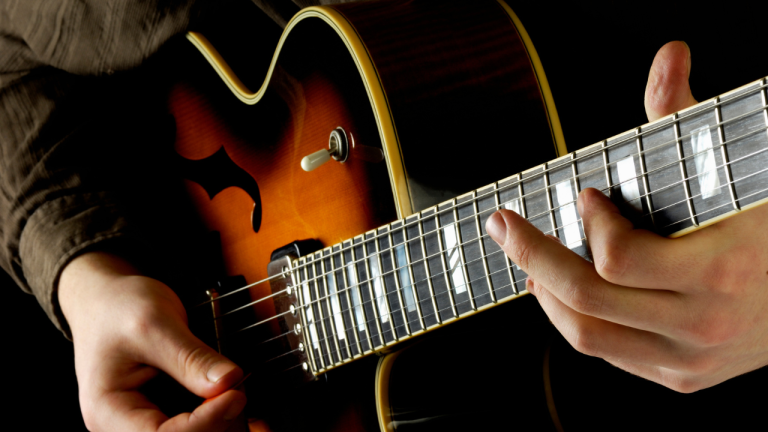
Jazz guitar for beginners can look intimidating from the outside. The chord voicings have unfamiliar names. The standards seem to have a thousand changes per chorus. The recordings move at speeds that feel impossible to follow. The reality is that jazz guitar is built on a small set of fundamentals, and any guitar player with basic chord and scale knowledge can start learning it today. In this guide, we’ll walk through what makes jazz guitar distinctive, the essential scales and chords every beginner should know, and how to structure your practice for steady, real progress.
Table of Contents
- What Makes Jazz Guitar Different
- Jazz Guitar for Beginners: Where to Start
- Easy Jazz Guitar Scales Every Beginner Should Know
- Essential Jazz Guitar Chords for Beginners
- How to Practice Jazz Guitar Day by Day
- Jazz Guitar Lessons with World-Class Faculty
What Makes Jazz Guitar Different
Jazz guitar differs from blues, rock, and folk guitar in a few important ways. Jazz harmony moves more often, with chord changes that frequently shift every two beats or every bar rather than every four bars. The voicings tend to be smaller and more economical, often three or four-note chord shapes that leave room for a bass player and a pianist. The melodic vocabulary draws on a wider set of scales and modes, including some that won’t be familiar to a blues or rock player. And jazz puts a high value on improvisation, where you compose melodies in real time over the chord changes.
That may sound like a lot, but the encouraging news is that none of it requires inherent talent or perfect pitch. Every great jazz guitarist started where you’re starting now: learning a few new scales, a few new chord shapes, and a few standard tunes, then putting in the consistent reps to make them fluent.
Jazz Guitar for Beginners: Where to Start
If you want to learn jazz guitar, three habits will serve you better than any single technique:
- Listen, deeply and constantly. Put on Wes Montgomery, Joe Pass, Grant Green, Kenny Burrell, Jim Hall, Pat Martino, and Charlie Christian. You can’t speak the language without hearing it spoken fluently. Listening trains your ears and your imagination at the same time.
- Learn songs, not just scales. Pick a standard, learn the melody, learn the chord changes, and play it every day for a week. Songs are the carriers of jazz vocabulary, and scales alone won’t get you there.
- Find a teacher who plays the music. Jazz is a tradition passed from player to player. Reading about it is helpful, and watching and working with someone who actually does the work will accelerate your progress dramatically.
Easy Jazz Guitar Scales Every Beginner Should Know
Easy jazz guitar scales are the building blocks of melodic improvisation. ArtistWorks instructor Dave Stryker walks through the most important ones in the video above. We’ll summarize each scale and what it’s used for, then point you to the lesson for the actual fingerings and applications on the fretboard.
The scales Dave covers in the lesson, in order:
- Major scale (Ionian). The familiar do-re-mi scale. Dave uses F major as the parent scale and derives the other modes from it.
- Dorian. Starting on the second degree of the major scale (G Dorian from F major). This is the most common minor scale in jazz. You’ll use it constantly over minor seventh chords.
- Phrygian. Third degree of the major scale (A Phrygian from F major). Carries a Spanish, flamenco-leaning flavor.
- Lydian. Fourth degree (B-flat Lydian from F major). Identifiable by its raised fourth. Use it over major seventh #11 chords (sometimes notated as “flat 5” major chords).
- Mixolydian. Fifth degree (C Mixolydian from F major). The dominant scale. Use it over dominant seventh chords like C7.
- Aeolian. Sixth degree (D Aeolian from F major). The natural minor scale. A natural sixth distinguishes it from Dorian.
- Locrian. Seventh degree (E Locrian from F major). Use it over minor seventh flat five chords (also called half-diminished).
- Pentatonic. A five-note scale. Often the very first scale a guitarist learns. Works over both dominant and minor harmonies.
- Minor blues scale. Add a chromatic note between the fourth and fifth of the minor pentatonic. Essential blues vocabulary that also lives comfortably inside jazz playing.
- Bebop scale (dominant). Based on the Mixolydian (dominant) scale with one extra chromatic passing tone added. The defining sound of bebop melodic phrasing.
- Bebop scale (major). The major scale with one extra passing tone (a sharp fifth) added. Same melodic principle applied to major harmony.
If you’re brand new to modes, start with three: the major scale, Dorian, and Mixolydian. Those three will cover the I, ii, and V chords in just about every jazz standard you encounter, which is more than enough to start improvising real solos over real tunes.
Essential Jazz Guitar Chords for Beginners
Jazz guitar chords are mostly seventh chords. The four shapes every beginner needs in their fingers, on every root, are:
- Major 7th (maj7): root, third, fifth, seventh. Warm and dreamy. Used on the I chord in major keys.
- Minor 7th (m7): root, flat third, fifth, flat seventh. The most common minor sound in jazz. Used on the ii chord and on many tonic minor situations.
- Dominant 7th (7): root, third, fifth, flat seventh. The “wants to resolve” chord. Used on the V chord in every key.
- Minor 7 flat 5 (m7b5 or half-diminished): root, flat third, flat five, flat seventh. Common as the ii chord in minor keys.
Learn these four shapes in two positions each (one with the root on the 6th string, one with the root on the 5th string), and you can play through almost any jazz standard you’d encounter on a typical gig.
How to Practice Jazz Guitar Day by Day
How to play jazz guitar comes down to consistent, focused practice. A 30-minute daily session, structured roughly like this, will produce real progress within a few months:
- 5 minutes: warm-up. A scale, a chord exercise, or a simple comping pattern.
- 10 minutes: tune of the week. Work on the melody and chords of a single standard you’re trying to internalize.
- 10 minutes: improvisation. Play through the form of the tune and improvise lines. Use only one or two scales at first. Record yourself.
- 5 minutes: listening reflection. Listen to a master playing the same tune. Notice one thing they do that you didn’t think to try.
Consistency beats intensity. Thirty minutes a day for six months will take you further than three-hour weekend marathons that leave your hands sore and your ears tired.
Jazz Guitar Lessons with World-Class Faculty
Jazz guitar lessons accelerate dramatically when you study with someone who actually plays the music. Dave Stryker, a Grammy-nominated jazz guitarist with decades of touring and recording experience, teaches a full curriculum on ArtistWorks covering everything from foundational technique to advanced improvisation. The scale lesson featured above is one small slice of his catalog. Fellow jazz guitar instructor Sean McGowan brings a complementary approach focused on harmony-rich arrangements and fingerstyle technique.
Both instructors use the ArtistWorks Video Exchange Learning model, in which you submit a video of your playing and receive personalized feedback from your instructor. That kind of structured, individualized guidance is one of the fastest paths from beginner to confident jazz player, and it’s something no book or app can replicate.
Start Your Jazz Guitar Journey with Personal Guidance
Jazz guitar for beginners is more accessible than it looks. A few scales. A few chord shapes. Consistent practice. Patient listening. And ideally, a great teacher to guide you. Every jazz guitar player you admire walked this same path at some point in their lives, and there’s no reason you can’t start walking it today.
Start a free trial at ArtistWorks and learn with personal guidance. Submit videos of your playing, receive personalized feedback from world-class faculty, and build the jazz guitar foundation that will carry you through a lifetime of music.