
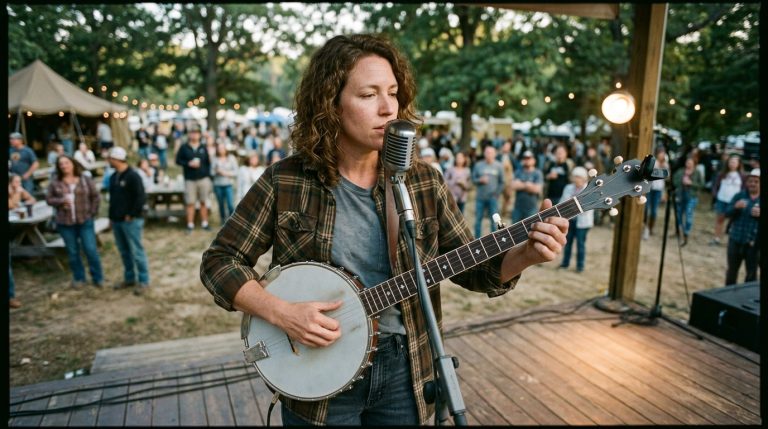
Vocal backup is the skill most banjo players never practice, yet it shows up in nearly every bluegrass jam and gig. You’re rolling along in G, the singer opens their mouth, and suddenly every note you play is fighting the melody for attention. That’s a problem worth solving. The good news is that the fix is simpler than most players expect: singers breathe. Those breathing gaps are your invitation.
This article focuses on reading vocal phrasing, building a ready-made lick vocabulary, and knowing when silence is actually the loudest thing you can play. For the bigger picture on all the situations you’ll face in a band, start with the full framework for bluegrass banjo backup and then come back here for the vocal-specific details.
Understanding Why Vocal Backup Feels Tricky
The banjo is a loud, percussive instrument. Its attack cuts through a mix fast. So when a singer is mid-phrase, a rolling pattern underneath doesn’t blend quietly. Instead, it competes. Most players don’t realize this because they’re focused on their own hands, not on listening across the band.
The solution starts with a shift in mindset. Think of your job during a vocal verse as complementary, not continuous. You’re not supposed to fill every beat. Instead, your goal is to decorate the space around the melody rather than underneath it.
How Vocal Phrasing Creates Natural Fill Windows
Every vocal line has a built-in structure. A singer delivers a phrase, takes a breath, and then delivers the next phrase. That breath is your cue. It’s typically two to four beats long, and it’s sitting there open, waiting for something musical to happen.
For example, listen to almost any classic bluegrass song. After “I am a man of constant sorrow,” there’s a gap before the next line. That gap is the fill window. A good banjo player drops one clean lick into that space, then pulls back immediately as the next word arrives.
Because these gaps are predictable, you can train yourself to anticipate them. First, listen to vocal tracks without playing. Then tap your finger on your knee every time you hear a natural pause in the lyric. Finally, practice inserting a single lick into each tap. That three-step exercise will change how you hear a song entirely.
Get video feedback on your playing from Alison Brown at ArtistWorksStart →
The Four-Beat Fill: Your Core Vocal Backup Tool
A four-beat fill is the practical unit of vocal backup. It’s long enough to say something musical. However, it’s short enough to be completely out of the way before the singer’s next phrase begins. Think of it as one measure of purposeful playing surrounded by two measures of tasteful restraint.
The notes you choose inside that four beats matter more than how many you play. A simple melodic phrase that references the chord you’re on will always land better than a flashy roll that ignores the harmony. Above all, end the lick cleanly. A fill that trails past the singer’s next downbeat is just as disruptive as never stopping in the first place.
Building Your Lick Vocabulary by Key
Here’s where preparation pays off. When a vocal hole opens up mid-song, you don’t have time to invent something. Instead, you reach into a mental library and pull out something that fits.
A practical goal is five G licks, five C licks, and five D licks. Those three chords cover the vast majority of bluegrass songs in G tuning. Pull these licks directly from tunes you already know. For instance, a turnaround phrase from “Foggy Mountain Breakdown” works beautifully as a G fill. A melodic snippet from a familiar C run can drop right into a vocal hole when the song moves to the four chord.
Because you learned these phrases in a musical context, they’ll always sound idiomatic. They won’t sound like exercises. In addition, borrowing from real tunes means your fills fit the genre’s vocabulary naturally rather than sounding invented on the spot.
Once you have fifteen licks under your fingers, practice rotating through them. Vary which one you use each time a hole appears. As a result, your backup becomes dynamic rather than repetitive. Other musicians in the band will notice, even if they can’t name what changed.
Vocal Backup When You Are the Singer
This situation deserves its own section because it trips up a lot of players. If you’re singing lead, your voice is already filling the melodic space. There’s nothing left for your banjo to add. In fact, rolling behind your own vocal line often works against you. It makes your voice work harder to project, and it muddies the dynamics for everyone else.
The better choice is to simplify dramatically. During verses where you’re singing, reduce your banjo to a rhythmic strum or a light vamp. Many experienced singers stop picking the banjo altogether during their vocal phrases and only re-engage during the holes or the chorus.
If you’re singing harmony rather than lead, the same principle applies. Your ear is partly occupied with pitch matching. Therefore, complex picking behind your own harmony part tends to drift off time or drift off pitch. Simplify the banjo, focus on the vocal, and come back in with fills only when you have clear space.
For how other instruments handle their own space questions during a vocal, how mandolin backup decisions work during a vocal chorus is worth a read. Similarly, what guitar and dobro players do to stay present without crowding gives you a useful outside perspective on the same problem.
Learn banjo with Alison Brown – Try a 7 day FREE trial!Start →
Practical Listening: Training Your Ear for Vocal Holes
The fastest way to improve vocal backup is not more practice time with your banjo. It’s more listening time without it. Put on a bluegrass record and give it your full attention as a student of phrasing. Notice where the singer breathes. Notice what the banjo player does in those moments. Notice what happens when a fill is too long or placed a beat too late.
This kind of active listening builds internal timing around vocal phrasing. Eventually, you won’t have to think about where the holes are. You’ll feel them coming before they arrive, which means your fill will be ready.
Putting Vocal Backup Into Practice Tonight
Start small. Pick one song you already know. Slow it down if you need to. Run through it and commit to playing fills only in the vocal holes, nowhere else. That constraint will feel uncomfortable at first, but it’s exactly the right kind of discomfort.
Then expand gradually. Add a second song, try a different key, work through your lick vocabulary until you’re rotating fills naturally. The goal is a backup style that supports the singer rather than competing with them.
For a complete look at all the backup situations you’ll encounter in a real bluegrass setting, the full banjo backup guide ties every piece together. How rolls and slides function behind a fiddle solo and why silence often works best behind a bass solo are both worth exploring once your vocal backup feels solid. Good backup is what gets you invited back. Vocal backup is where most players have the most room to grow.
Learn Banjo with Alison Brown at ArtistWorks!Start →
About the Education Team
Four music-industry veterans with decades of combined experience in music education, curation, and production at TrueFire and ArtistWorks. The TrueFire Studios Education Team plans and edits this content and works with our master-musician faculty to keep it accurate and genuinely useful.
Featured Contributor
A GRAMMY-winning banjo player blending bluegrass and jazz, she’s performed with Alison Krauss & Union Station and Michelle Shocked, led her own quartet since 1993, recorded 12 acclaimed solo albums with multiple GRAMMY nods, and co-founded Compass Records Group.