
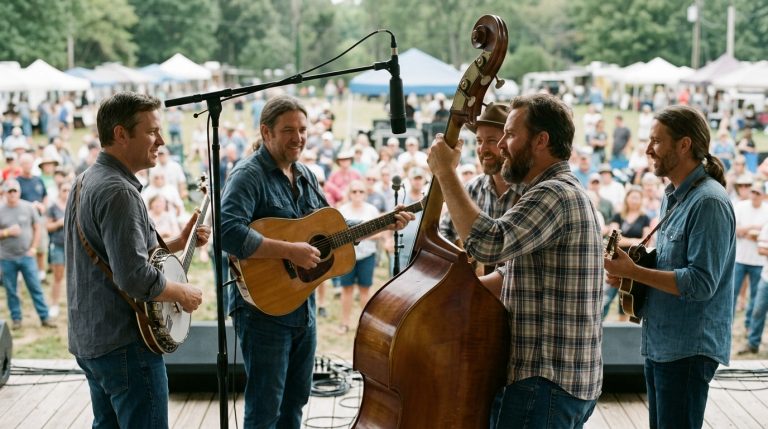
Backing up a bass solo is one of those moments that quietly separates experienced bluegrass players from nervous newcomers. Most players freeze, unsure what to do. Others keep strumming, hoping nobody notices. But the real answer is almost always the same: stop playing entirely, or play so little that the bass owns the room.
This article is your guide to that choice. It connects directly to the broader framework in our full banjo backup guide, which maps every common soloist situation you’ll face in a band setting. Here, we go deep on one specific moment, because backing up a bass solo deserves its own honest conversation.
Backing Up a Bass Solo: What Actually Happens in Most Bands
In most bluegrass bands, everyone stops when the bass player steps up to solo. This is not a failure of imagination. It is a deliberate tradition, and it works.
The bass lives in the low register. Every open string rings deep. The instrument’s natural voice fills the low end immediately. So when the bass solos, any other low-frequency instrument crowds that space fast. The banjo’s fourth string sits right in that zone. Even one stray note there can muddy the texture.
Furthermore, bass solos are relatively rare in bluegrass. They carry a certain novelty. The audience leans in. Silence around the soloist actually amplifies that attention. The band is, in effect, framing the moment.
So if you’ve ever stood there doing nothing and felt vaguely guilty about it, let that feeling go. Doing nothing is often the most musical thing in the room.
Get video feedback on your playing from Alison Brown at ArtistWorksStart →
Treating Silence as Something the Band Actively Plays
Here is a shift worth making in how you think about empty measures. Silence is not a gap. It is a sound the whole band is creating together.
Think about it this way. A drummer who lays out for two bars is not absent. Instead, that drummer is actively choosing space. The same logic applies to you. When you lift both hands off the banjo and let the bass breathe, you are making a musical decision. That decision takes confidence.
In contrast, filling out of nervousness sounds exactly like filling out of nervousness. Bandmates hear it. The audience feels it. The bass player definitely notices.
Try this exercise: At your next jam, lift both hands off the banjo for a full chorus while the bass solos. Just sit there. Let it be quiet. At first, it feels uncomfortable. Eventually, it starts to feel intentional. That is the goal. You want to reach the point where silence sits as easily as a well-placed roll.
Backing Up a Bass Solo When You Do Choose to Play
Occasionally, the musical moment calls for something. Maybe the tune has a long solo section. Maybe the bass player signals they want company. In that case, backing up a bass solo requires one firm rule: stay out of the low register entirely.
Ignore the fourth string. Pretend it is not there. Instead, focus on the top three strings only. Play small, quiet triads that float above the bass’s register. Keep your right hand light. Think of it as putting a thin wash of color on the wall rather than painting the whole room.
Specifically, look for chord voicings that work without the fourth string. On a G chord, for example, you can fret the first, second, and third strings in a way that outlines the chord cleanly. The fourth string stays silent. As a result, the banjo sits up in the mix without competing with the bass’s frequencies.
Simple Chord Moves That Accent Without Overpowering
When you do play during a bass solo, simplicity is your greatest tool. Small, expressive chord changes do more than busy patterns.
For example, moving from a G to a G7 takes one finger. That single shift adds harmonic color. It signals the chord change without a roll, without a fill, without any noise that covers the soloist.
Similarly, adjusting a finger to form a C7 instead of a plain C gives the music forward motion. These tiny moves are essentially conversation. You are quietly agreeing with what the bass is saying.
In contrast, a full roll pattern during a bass solo plants a flag in contested territory. The banjo suddenly has an opinion, and that opinion is louder than the soloist’s voice. For this reason, avoid rolls entirely when the bass is leading. Think: a single strum, then silence. Or one triad held for two beats, then nothing.
If you want to explore how this idea of restraint connects across other solo situations, the mandolin backup article covers a similar philosophy. There, the banjo pulls back and finds space through chops and selective rolls. The same instinct applies here, only more so.
Learn banjo with Alison Brown – Try a 7 day FREE trial!Start →
The Practice That Makes Silence Feel Natural
Most players never practice silence. They practice notes. But silence is a skill. It requires you to feel comfortable in the band without doing anything.
Here is a concrete exercise. Record yourself playing a full tune alone. Then, on playback, identify every moment where a bass solo might land. Listen to how those measures feel. Next, play the tune again live and stop completely during those measures. Notice the difference. The silence will feel loud at first. Gradually, it will feel like breathing room.
Additionally, practice your three-string triads separately, away from the full tune context. Get them under your fingers so they never require focus during a real performance. The goal is to have both options ready: full silence or a quiet triad. You want the choice to feel calm, not desperate.
For a deeper look at how to stay present without intruding in other contexts, the article on staying present without getting in the way covers that territory directly. Also, the full picture of how backup choices fit together across every solo situation is waiting in our complete banjo backup guide.
Your Next Step: Own the Moment of Quiet
Backing up a bass solo with confidence is a sign of musical maturity. It means you trust the music, trust your bandmates, and trust yourself. The next time the bass steps forward, try full silence first. Feel the weight of it. Then decide, based on the music in front of you, whether one quiet triad might add something. In most cases, the empty measure will feel exactly right.
Learn Banjo with Alison Brown at ArtistWorks!Start →
About the Education Team
Four music-industry veterans with decades of combined experience in music education, curation, and production at TrueFire and ArtistWorks. The TrueFire Studios Education Team plans and edits this content and works with our master-musician faculty to keep it accurate and genuinely useful.
Featured Contributor
A GRAMMY-winning banjo player blending bluegrass and jazz, she’s performed with Alison Krauss & Union Station and Michelle Shocked, led her own quartet since 1993, recorded 12 acclaimed solo albums with multiple GRAMMY nods, and co-founded Compass Records Group.