
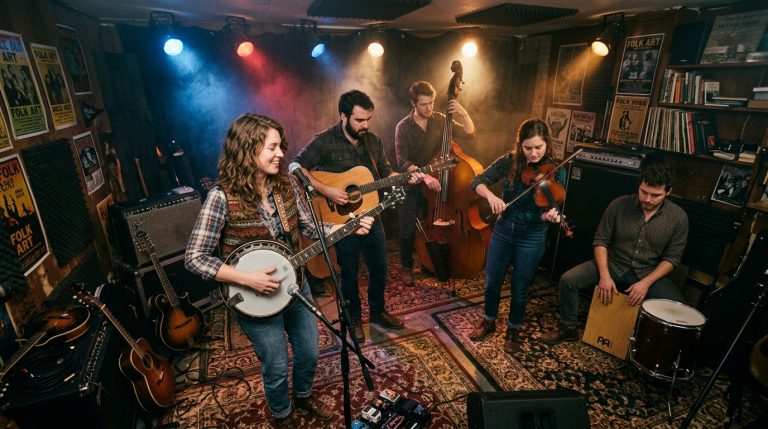
Fiddle backup on banjo is one of the most satisfying jobs in a bluegrass band. When the fiddle player steps up for a break, you suddenly have breathing room. Nobody is watching your right hand for the melody. Nobody cares if you leave a gap. Instead, your job is simple: push the music forward and keep the energy climbing. That is a different skill than soloing, and it is worth practicing on its own terms.
If you have been thinking through the broader framework for banjo backup, this article zooms in on one specific situation. Fiddle breaks reward a particular combination of rolling technique and slow, deliberate slides that can transform your backup from polite chord strumming into something that genuinely propels the band.
Why Fiddle Backup Calls for a Different Approach
The fiddle lives in a bright, singing register. It cuts through the band with ease. Because of that, the banjo does not need to fight for space. Instead, you can sit comfortably underneath the fiddle and focus on momentum rather than presence.
That shift in mindset changes everything about your technique. Chop strokes, which work beautifully behind a mandolin break, can feel choppy and intrusive under a fiddle. The fiddle already has rhythmic clarity. What it needs from you is forward motion, a sense of rolling energy that keeps the measure moving toward the next chord.
Forward rolls are your primary tool here. Specifically, a consistent right-hand roll pattern gives the fiddle player something to lean against rhythmically. Think of your roll as the current in a river. The fiddle melody floats on top. Your job is to keep that current steady and strong.
Get video feedback on your playing from Alison Brown at ArtistWorksStart →
The Fourth-String Slide: Slow Enough to Hear Every Fret
The technique that separates good fiddle backup from great fiddle backup is the slide. Specifically, a slide on the fourth string from the second fret up to the fifth fret. This two-to-five slide adds warmth and forward momentum at the same time.
However, the most common mistake is rushing the slide. Quick slides disappear in the mix. They read as a blip, nothing more. The goal is a slide slow enough that you can hear your fingertip passing through each fret along the way. That means you are not just landing on the target note. You are traveling to it, and the listener hears every step of that journey.
Practice this in isolation first. Set a slow tempo, around 60 BPM. Pick the fourth string open, then start your slide on the downbeat and arrive at the fifth fret on beat two. Then try beginning at the second fret and arriving at the fifth fret across a full beat. You will feel the difference immediately. The slow version has weight and gravity. It pulls the phrase forward in a way that a quick flick simply cannot.
Once you have the slide feeling comfortable, layer it back into your forward roll. The roll keeps running underneath. The slide happens on top of it, voiced on the fourth string while your thumb continues its pattern. That combination of rolling momentum and slow melodic travel is the heart of effective fiddle backup.
Moving Up the Neck to Match the Fiddle
Here is where fiddle backup gets genuinely interesting. Fiddle players climb. They move into higher registers during their most expressive moments, and if you stay parked at the first few frets, you leave a gap in the sonic picture.
The solution is to follow them up the neck. Practice shifting from a G chord at the fifth fret to a G chord at the ninth fret. The key is keeping your ring finger and pinky anchored on their strings while your inside fingers flip positions. That anchoring gives you a stable reference point during the shift. As a result, your fretting hand stays organized even at tempo.
Start by practicing the shift slowly without any roll. Just fret the chord at the fifth fret, lift and move, land cleanly at the ninth fret. Next, add the roll back in and practice transitioning between the two positions. Finally, work in your slide within each position before combining the position shift and the slide together.
When the fiddle player climbs into a high, singing phrase, following them up to a G triad around the seventeenth fret puts you in their sonic neighborhood. You are not playing the melody. You are not duplicating what they are doing. Instead, you are matching their altitude and keeping the band’s energy unified in that upper register.
Learn banjo with Alison Brown – Try a 7 day FREE trial!Start →
Listening and Responding: Playing Fiddle Backup Along With Recordings
The best way to develop fiddle backup instincts is to play along with actual fiddle recordings. Put on a classic bluegrass album and assign yourself the backup role only. Do not solo over the fiddle breaks. Instead, roll, slide, and shift positions in response to what the fiddle player is doing.
Focus on two things at first. First, match their register as they move up and down. Second, time your slides to land on chord changes. That second point takes real listening. You need to hear the chord change coming one beat ahead of time so your slide can travel toward the new chord and arrive exactly on the downbeat. That is active listening, not passive playing.
Of course, this skill connects to everything else happening in the band. For tips on keeping your backup responsive across different soloist situations, revisit the full banjo backup framework.
If you want to explore how your backup role shifts when the singer steps up, the approach to vocal backup on banjo covers exactly that territory. Understanding when to stay out of the way behind guitar and dobro will also sharpen your overall sense of register and space.
Putting It All Together in a Band Setting
In a live setting, fiddle backup rewards preparation and spontaneity in equal measure. Because you have drilled the fourth-string slide and the neck position shifts, your hands are ready to respond. Therefore, your ears are free to actually listen.
Start simple. Choose one position, run your forward roll, and add one slow slide per measure on the chord change. That alone will sound more musical than busy, scattered backup. Then, as you get comfortable, start tracking where the fiddle player is on the neck and follow them.
In short, fiddle backup is a conversation. Your rolls provide a steady pulse. Slides add expression and forward pull. Your position shifts keep you in the same register as your bandmate. Together, those three elements turn the banjo from a rhythm machine into a genuine musical partner during the fiddle break.
Learn Banjo with Alison Brown at ArtistWorks!Start →
About the Education Team
Four music-industry veterans with decades of combined experience in music education, curation, and production at TrueFire and ArtistWorks. The TrueFire Studios Education Team plans and edits this content and works with our master-musician faculty to keep it accurate and genuinely useful.
Featured Contributor
A GRAMMY-winning banjo player blending bluegrass and jazz, she’s performed with Alison Krauss & Union Station and Michelle Shocked, led her own quartet since 1993, recorded 12 acclaimed solo albums with multiple GRAMMY nods, and co-founded Compass Records Group.