
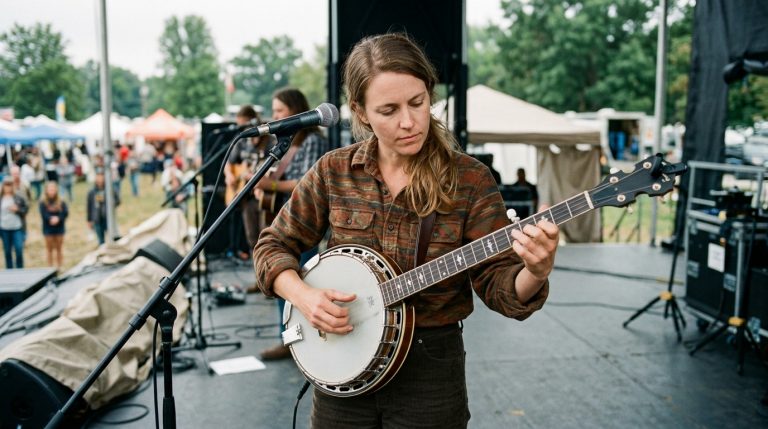
Banjo backup becomes a real test of musicianship the moment the guitarist or dobro player steps into the spotlight. In those moments, your job is not to fill every inch of sonic space. Instead, your job is to keep the band locked in and the energy moving forward, all without cluttering the mix. That balance is tricky, because both situations ask you to think differently about your role.
This article focuses on two specific challenges: what to do when the guitarist solos, and how to navigate the sonic overlap between banjo and dobro. For a broader look at backup thinking across all soloist situations, check out this practical framework for every soloist situation.
Why Banjo Backup Gets Complicated When the Guitarist Solos
Guitar is the quietest instrument in a bluegrass band. Most players understand that fact in theory, but fewer think through what it means in practice. When the guitarist steps up to solo, the overall rhythmic energy in the band can drop noticeably. As a result, the whole group tends to unconsciously drag the tempo, because that steady, authoritative drive disappears for a moment.
Your natural instinct might be to fill the gap with rolling or vamping. However, that approach can add melodic clutter right when clarity matters most. The guitarist needs room to breathe and be heard. So the real problem is not adding more sound. The problem is maintaining pulse without adding noise.
The Percolator: A Quiet Fix for Tempo Stability
Here is a specific technique worth learning. Mute all six strings with your left hand and play a quiet, steady forward roll with your right. Because the left hand kills all pitch, the banjo produces only a soft, rhythmic click. That click functions like a silent metronome for everyone around you.
Think of it as a percolator. It keeps things moving without announcing itself. In fact, the rest of the band will feel the pulse stabilize even if they never consciously notice your banjo. That is exactly the goal. Keep the roll even and straight, with no swing and no syncopation. Straight 16th notes give the band a clean rhythmic anchor. Meanwhile, the guitarist can solo freely, confident that the momentum will not drift underneath them.
Start with this technique in low-stakes settings first. For example, try it during a practice session before you bring it to an open jam. You will quickly notice how much steadier things feel, even when no one else in the room realizes what changed.
Get video feedback on your playing from Alison Brown at ArtistWorksStart →
Banjo Backup and the Dobro: Understanding the Sonic Overlap
The dobro challenge is a different kind of problem entirely. Because banjo and dobro share the same four strings and operate in a similar register, the two instruments can collide easily. In contrast to backing up guitar, the issue here is not tempo. Instead, the issue is texture and frequency.
When two instruments occupy the same sonic space and play similar patterns, they cancel each other out rather than complement each other. As a result, your backup loses its effectiveness, and the dobro player’s solo gets muddied. The answer is not to simply play quieter. The answer is to choose a different approach entirely based on what the dobro is doing.
How to Read the Dobro and Choose Your Response
First, listen to the dobro player during the opening bars of their solo. Specifically, notice whether they are chopping or rolling. That distinction tells you everything you need to know.
If the dobro is chopping, the rhythmic chop creates a percussive staccato pulse. In that case, you can roll. Your forward roll fills in the space between their chops and creates a combined texture that is richer than either one alone. However, if the dobro is rolling heavily in G position, the hand shapes and note choices tend to clash directly with common banjo roll patterns. In that situation, back off. Find a different texture, perhaps sparse vamping, muted tones, or even a rest.
This kind of listening is exactly what separates good backup from great backup. Moreover, it is a skill you can develop deliberately. In your next jam, identify what the dobro is doing in the first two bars of their solo. Then choose the opposite approach before you commit to a pattern. Roll when they chop. Simplify when they roll. That one habit will transform your banjo backup in a band context.
Learn banjo with Alison Brown – Try a 7 day FREE trial!Start →
Banjo Backup: Putting These Ideas Together in a Real Jam
These two techniques, the percolator and the dobro response, share a common principle. Both ask you to prioritize the band over your own playing. That is, of course, the core of any great backup role. Because you are focused on what others need, your contributions become more valuable, not less.
For a deeper dive into how these ideas apply when the mandolin player solos, see how chopping and rolling work together on banjo. And if you have ever wondered whether doing nothing is actually the right call, this look at backing up a bass solo makes a strong case for restraint. Meanwhile, if you want to understand how to fill space when the vocalist steps forward, vocal backup strategies for banjo covers that angle directly.
Your Next Step: Quiet Presence as a Skill
Staying present without getting in the way is genuinely hard. In fact, it often takes more control than playing something complicated. The percolator roll requires you to suppress your instinct to add melody. The dobro response requires you to listen before you play. Both habits, therefore, build the kind of musical awareness that makes you an indispensable bandmate.
Return to the full banjo backup guide whenever you want to zoom out and see how all five soloist situations fit together. Each one has its own logic, and understanding the full picture makes each individual situation easier to navigate. Above all, remember that the best backup player in the room is usually the one you barely notice. Everything just feels better when they are there.
Learn Banjo with Alison Brown at ArtistWorks!Start →
About the Education Team
Four music-industry veterans with decades of combined experience in music education, curation, and production at TrueFire and ArtistWorks. The TrueFire Studios Education Team plans and edits this content and works with our master-musician faculty to keep it accurate and genuinely useful.
Featured Contributor
A GRAMMY-winning banjo player blending bluegrass and jazz, she’s performed with Alison Krauss & Union Station and Michelle Shocked, led her own quartet since 1993, recorded 12 acclaimed solo albums with multiple GRAMMY nods, and co-founded Compass Records Group.