
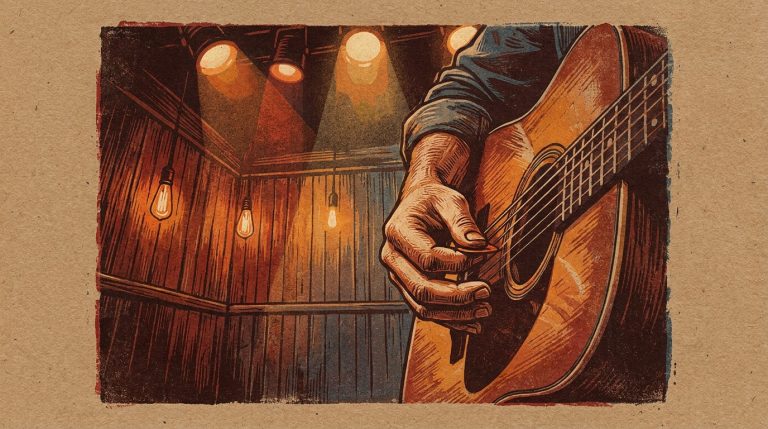
Your picking hand posture is probably built on a flawed picture. Not because you chose the wrong technique, but because most advice describes the surface of what the hand does, not the actual mechanics underneath. Phrases like “attack the string,” “keep the elbow tight,” and “strum from the wrist” all miss the deeper reality. That gap between description and reality is where tension, inconsistency, and plateaus live.
Dave Isaacs, a Nashville-based guitarist and educator who has spent decades refining how he teaches these physical fundamentals, points to awareness as the missing ingredient most players never develop.
This article introduces the single-rotation model that underlies every picking-hand movement. It also maps out the five concepts that build from that model. Each section below connects to a deeper post where the mechanics get unpacked in full. Read through here first. You will leave with the right mental picture. Then the detailed work in each lesson will make a lot more sense.
The Single Movement Behind Every Picking-Hand Technique
Before you can fix picking hand posture, you have to understand what the hand is actually doing. So the answer is simpler than most guitarists expect. Every motion the picking hand makes is a rotation. That holds true from a quiet fingerstyle brush all the way to a full open strum. The forearm rotates around its own axis, the pick rides along with that rotation. And the rest is just a question of how far the rotation travels and how much of the arm is involved.
This is not a metaphor. The forearm contains two bones, the radius and the ulna. They are literally designed to rotate around each other. When you strum down, the forearm rotates in one direction. On the return of the upstroke, it rotates back. When you pick a single note, you use a small piece of that same motion. Understanding this changes everything about how you diagnose problems and how you practice.
Most picking issues come from fighting this rotation. Players pump the elbow, collapse the wrist, lock the forearm, or grip the pick too hard. All of those habits interrupt the natural rotation. Because good picking hand posture creates the conditions for that rotation to happen freely, posture is not separate from technique. It is the foundation technique rests on.
Check out Dave Isaac’s Session Player Toolkit curriculum at ArtistWorksStart →
Why Single Notes and Full Chords Share the Same Motion
The most common misunderstanding about picking is that single-note playing and chord strumming require different physical actions. But they do not. The brain sends the same signal. Only the degree of follow-through changes. So for a single note, the rotation barely starts before it stops. For a full strum, that rotation sweeps through all six strings without interruption.
This matters practically. If you treat them as separate skills, you end up with two different setups and two different arm positions. That creates a constant adjustment tax every time you switch between them. Instead, think of it as a single physical event that can be scaled. The more deeply you internalize that single-notes and chord strumming belong to the same physical family, the easier it becomes to move between them fluidly in real playing.
Good picking hand posture supports both without changing. The arm position that works for a light fingerpick works for a full strum too. You are just unlocking more of the motion.
What the Pick Is Actually Doing at the String
Here is a mental model that will immediately improve your tone and control: the pick does not strike the string. It glides across it. The string is curved. The pick is a flat, angled surface. When those two things meet with the right approach angle, the string releases cleanly. The pick moves through without catching. When the pick comes at the string like a hammer, you get clicky attack, excessive noise, and resistance that tires your hand out fast.
Changing the mental model changes the physical result. “Glide” produces a different arm and wrist position than “strike.” Specifically, it encourages you to hold the pick at a slight angle rather than perfectly perpendicular to the strings. And it also encourages a relaxed grip rather than a tightened one. So the tone improves, and so does your endurance. Next, dig deeper into how this gliding contact changes your clean tone and you will likely rethink how you have been holding the pick for years.
This is also where picking hand posture becomes audible. The angle of your forearm, the height of your wrist, and the tilt of the pick all shape how the pick meets the string. A small adjustment in posture produces a noticeable change in sound.
Get direct personalized video coaching from Dave Isaacs at ArtistWorksStart →
Picking Hand Posture and the Quiet Strum
Light strumming is where many players first notice something is wrong. The strum sounds thin, or the volume control feels disconnected from intent, or the arm works hard to stay quiet and tires out. And the culprit is almost always the same. The player is trying to shrink the strum by shrinking the arm’s effort, rather than by limiting the rotation’s range.
A quiet strum is a small rotation, not a pumped arm moving slowly. The physical center of the motion shifts toward the wrist and forearm rather than the elbow. So the pick barely passes the sounding strings before the motion reverses. And that is all it takes. As a result, the arm can stay relaxed even at low volume. It is not fighting itself to stay quiet.
Picking hand posture plays a direct role here. If the wrist is locked or the forearm is braced against the body, the small rotation has nowhere to come from. The arm compensates, and control disappears. Learn how to keep light strums consistent without losing control and you will see how much posture and motion range are connected.
Why Power Comes From Follow-Through, Not Force
The natural assumption is that a louder, more projecting strum requires more force. In practice, it requires more follow-through. The difference is significant. Force means gripping harder and pushing down against the strings. Follow-through means letting the rotation travel its full arc. It means adding arm weight rather than muscle tension.
When you force a strum, the pick catches, the tone chokes, and the chord sounds aggressive rather than full. When you allow full follow-through with arm weight behind the motion, the strings ring freely. The sound projects without that pushed quality. This is why large-bodied acoustic players often look almost effortless when they strum hard. They are not working against the guitar, they are releasing through it.
Picking hand posture enables this. The arm needs to be free at the elbow and loose at the wrist to generate that kind of follow-through. Tension anywhere in the chain kills it. Explore why follow-through is the real source of a bigger, fuller strum to understand how to build this without adding effort.
Get direct personalized video coaching from Dave Isaacs at ArtistWorksStart →
Picking Hand Posture and the Upstroke Problem
Most players treat the upstroke as a separate technique. They approach it as something to be developed on its own with dedicated practice. That framing actually creates the problem it is trying to solve. When you think of the upstroke as a distinct action, you actively initiate it. That means a second muscular event, a second decision, a second moment of tension. Speed and smoothness both suffer.
Instead, consider this: the upstroke is simply the return. After the forearm rotates down for a downstroke, gravity and the forearm’s natural rebound bring it back. That return is your upstroke, nothing extra needs to happen. The pick catches a string or two on the way back. That is the upstroke sound. When you stop trying to “do” the upstroke and instead allow the return, the two directions suddenly feel connected rather than alternating.
This reframe has a direct effect on picking hand posture as well. Players who actively initiate upstrokes often raise the elbow or shift the wrist position on every other note. So that micro-adjustment adds latency and inconsistency. Letting the upstroke be a return keeps the arm in one place. Read more about treating the upstroke as a return to neutral and you will immediately hear the difference in your alternate picking runs.
The Role of Awareness in Good Picking Hand Posture
Dave Isaacs frames all of this around a concept that technique instruction rarely addresses directly: physical awareness. Knowing the principles is one thing. Feeling them while you play is another. As Isaacs puts it, “It’s being able to be aware of your movements in space and to also be able to feel how your body moves. We are just as a rule, not very tuned in and the more you can tune in to how you’re moving and what you’re feeling, the better you’re going to play.”
That quote points to something important. The five principles in this cluster are not checklists to run through before every practice session. They are qualities to develop in your sense of what your hand is doing. First, you have to slow down enough to feel the rotation. Then you can notice where the tension lives. Finally, you can recognize what free movement actually feels like in your hand and arm.
Picking hand posture, in that sense, is not a position you set and forget. It is a relationship between your arm, the guitar, and your attention. The more you cultivate that attention, the more consistently the mechanics fall into place without effort.
Putting the Five Principles Together
Each of the five concepts in this cluster builds directly on the single-rotation model. First, recognizing that single notes and chords use the same fundamental movement removes an artificial distinction. Next, understanding that the pick glides rather than strikes changes your approach angle and your tone. From there, quiet strums become a question of rotation range, not effort level. Power strums become a question of follow-through, not force. Finally, the upstroke, seen as a natural return rather than a separate technique, ties the whole motion together into one continuous event.
None of these principles require exceptional talent or unusual hand size. They do require a willingness to rebuild your mental picture of what your hand is doing. And that process starts with posture, because posture either allows these movements or prevents them. Get the foundation right, and the specific techniques become much easier to feel and execute.
Continue Learning
Each of the posts below goes deeper on one aspect of picking hand posture. Work through them in order for the clearest progression from fundamentals to full strumming technique.
- Why single notes and chords are really the same motion
- Drop the “strike” model and pick strings more cleanly
- Keeping your light strums quiet and controlled
- How follow-through unlocks a bigger, fuller strum
- How to think of the upstroke as a return, not a separate pull
Final Thought
The picking hand is doing something simpler than most players realize. One rotation, scaled to fit the situation. Picking hand posture is the structure that allows that rotation to happen cleanly, consistently, and without tension. If your technique feels complicated right now, that complexity is likely a symptom of a flawed picture, not a lack of skill. Swap the picture, then let the videos show you what the mechanics look like up close.
Take your guitar playing to the next level with Dave Isaacs at ArtistWorks!Start →
About the Education Team
Four music-industry veterans with decades of combined experience in music education, curation, and production at TrueFire and ArtistWorks. The TrueFire Studios Education Team plans and edits this content and works with our master-musician faculty to keep it accurate and genuinely useful.
Featured Contributor
A Nashville guitarist, songwriter, and veteran music educator, he’s known for teaching musicianship, confidence, and practical guitar skills. He performs across rock, blues, country, jazz, and folk styles, and is a Manhattan School of Music graduate and former university music instructor.