
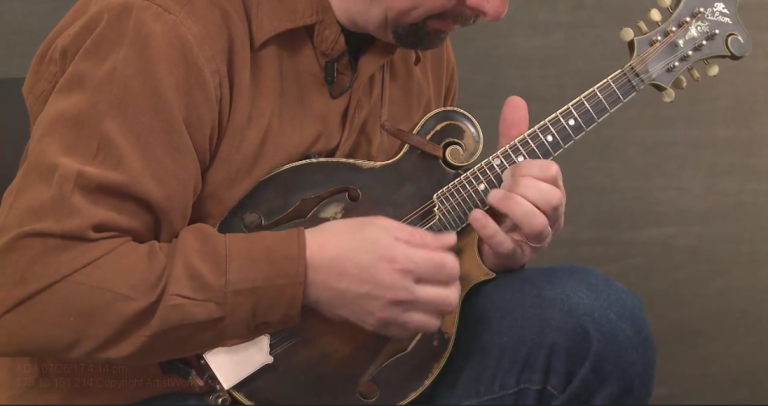
You tune up your mandolin, play a G chop or a simple melody, and something feels wrong. The strings fight back. Notes fret sharp up the neck. A clean pick stroke turns into a buzz. A lot of players assume that means they need more practice, or a better instrument, or tougher fingertips.
Sometimes the problem is simpler. The mandolin hasn’t been set up to play well.
A good setup changes how an instrument responds under your hands. Chords stop feeling like work. Single-note lines ring instead of choking out. Intonation stops distracting you. The whole instrument starts helping instead of resisting. That’s why any serious mandolin setup guide should do more than list measurements. It should connect each adjustment to what you hear and feel when you play.
Why a Good Setup Is Your Secret to Better Playing
A lot of mandolins lose players in the first few weeks. The instrument is tuned, the chords are recognizable, and the player is trying hard, but every session feels like extra work. The left hand squeezes harder than it should. The right hand backs off to avoid buzz. Notes higher up the neck never quite settle into tune.
That kind of fight changes how you play. It teaches you to compensate for the instrument instead of learning clean technique and good time. I see it all the time with otherwise motivated players, especially on factory-fresh instruments that have never been dialed in after shipping or a season change.
A good setup fixes causes, not symptoms.
If the bridge sits in the wrong place, the mandolin will sound sour up the neck no matter how carefully you tune the open strings. If the action is too high, your fretting pressure goes up and your intonation often gets worse with it. If the nut slots are too high or poorly shaped, first-position chords feel stiff and the strings may not return to pitch cleanly after tuning.
A good setup is how you turn a mandolin from a box of correct parts into an instrument that responds musically.
That is why setup matters so much. The goal is not to chase numbers for their own sake. The goal is to make the mandolin feel easier under the fingers, sound cleaner under the pick, and stay predictable from the first fret to the last.
What you hear and feel after a solid setup
The first improvement is usually comfort. Fretted notes speak with less effort, which means less hand tension and better control over vibrato, double stops, and clean chord shapes.
The second is clarity. A mandolin with sensible relief, action, and bridge position has more of the quick, focused response players want. Tremolo holds together better. Chops sound drier and more direct. Single-note lines stop feeling cramped.
Then comes confidence. Once the instrument plays in tune and responds evenly, you stop second-guessing every note. That matters whether you are learning fiddle tunes by ear, backing up a singer, or working on tremolo and phrasing with a mandolin learning program at ArtistWorks.
There is also a trade-off to respect. Very low action can feel fast, but if you play hard for bluegrass rhythm it may buzz and lose headroom. Slightly higher action can give the top more room to work and keep the sound cleaner under a strong pick attack. A good setup matches the player, not just the ruler.
Some jobs are straightforward. Bridge placement, string choice, and a basic action check are well within reach for a careful beginner. Truss rod adjustments, nut work, and fret problems deserve more caution. If a change takes force, if the neck does not respond as expected, or if buzzing persists in one area of the fingerboard, stop and hand it to a repair person. Good judgment is part of a good setup too.
Gathering Your Essential Setup Tools
Before touching the bridge or reaching for the truss rod, lay out the tools. Setup goes badly when players try to eyeball tiny changes or use the wrong wrench “just this once.” Mandolins respond to small adjustments, so your tools need to let you work small.
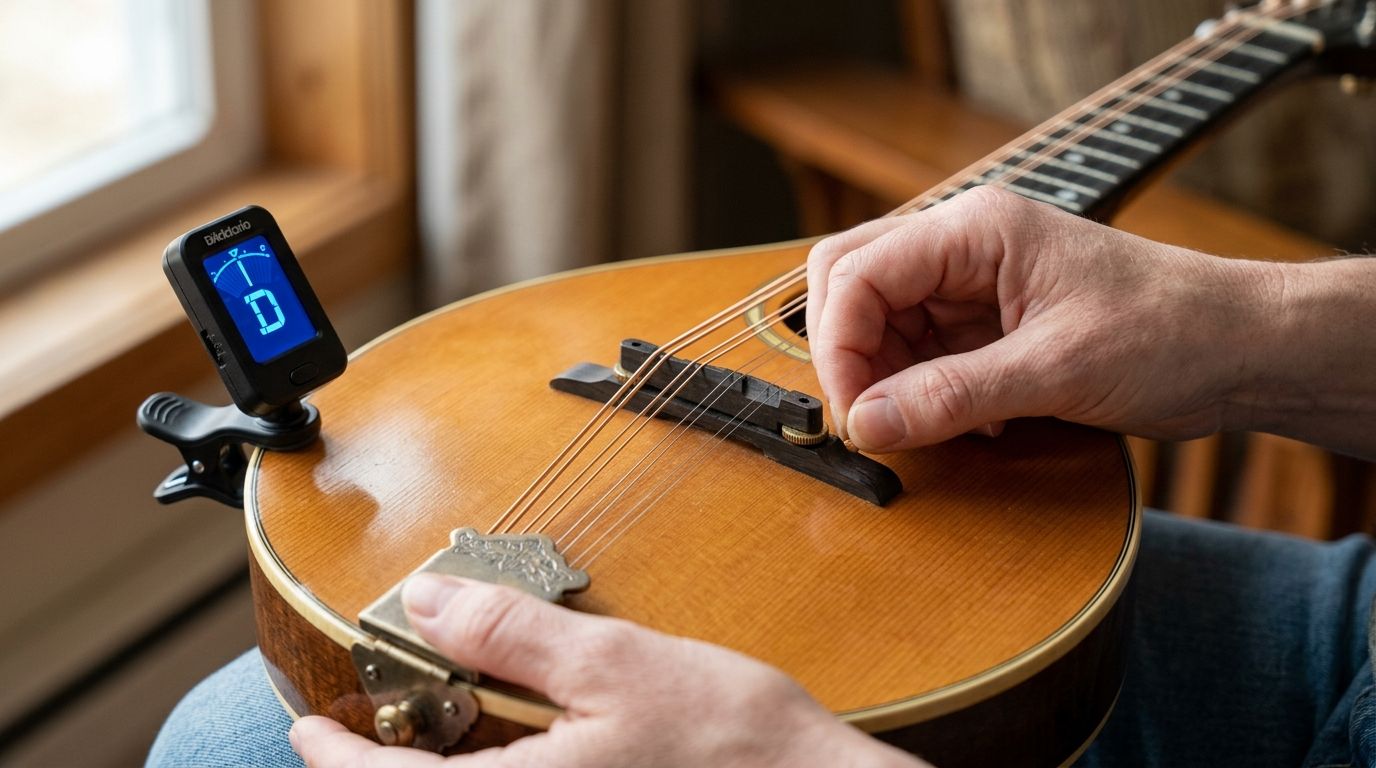
Tools I consider essential
A basic mandolin setup kit should include:
- A digital tuner that reacts quickly and reads accurately. Intonation work depends on this. If the tuner drifts or lags, you’ll move the bridge in the wrong direction.
- Feeler gauges for checking very small gaps. Neck relief on a mandolin lives in a tiny window, and this is one place where guessing by eye doesn’t cut it.
- A small ruler with fine markings for measuring string height at the fretboard. A short machinist-style rule is easier to use than a bulky tape measure.
- A peg winder and wire cutters for string changes. Clean restringing matters more than many players think.
- The correct truss rod wrench for your instrument. “Close enough” is how nuts get rounded off.
Those tools let you measure, adjust, and then return to the same baseline if needed. That repeatability is the true value.
Useful extras that save frustration
Some items aren’t mandatory for a first pass, but they make life easier:
| Tool | Why it helps |
|---|---|
| Nut lubricant or graphite | Reduces binding at the nut during tuning |
| Small flashlight | Helps you inspect nut slots, bridge angle, and fret contact |
| Soft cloth or mat | Protects the instrument while you work |
| Pencil | Lets you mark current bridge position before moving anything |
If you’re learning setup and technique side by side, Mike Marshall’s ArtistWorks school also includes mandolin-focused instruction that can help you hear the difference between a mechanical issue and a picking issue.
Shop habit: Put every tool within reach before you start. Mid-job searching leads to rushed decisions, and rushed decisions lead to bad setup work.
What not to improvise
There are a few shortcuts I’d avoid.
- Don’t use oversized pliers on hardware meant for a proper wrench.
- Don’t measure action with a tape measure if a fine ruler is available.
- Don’t file a nut slot with random hardware-store tools unless you’re fully prepared to replace the nut if it goes wrong.
Mandolin setup rewards patience. The right tool slows you down just enough to do clean work.
Bridge Placement and Perfecting Intonation
Bridge placement is the first adjustment I check on almost any floating-bridge mandolin. If the bridge sits in the wrong spot, the instrument can be perfectly tuned open and still sound wrong everywhere that matters.
That’s why this comes first in a practical mandolin setup guide. You need the scale length working properly before you judge anything else.

The basic intonation method
A reliable workflow is laid out in this mandolin intonation setup guide from Dummies. The sequence is straightforward: tune the open strings, compare the fretted octave at the 12th fret with a digital tuner, and move the bridge in very small increments. If the fretted note is flat, move the bridge toward the neck. If it is sharp, move it toward the tailpiece. That same guidance notes that even 1–2 mm can materially change intonation.
That last part matters. Players often move the bridge too far, then chase the problem back the other way.
How to do it without creating new problems
Use this order:
- Tune the open strings cleanly. Don’t rush. If the open course is off, every comparison afterward is misleading.
- Check the fretted note at the 12th fret. Use a normal playing touch. Don’t press harder than you would in real playing.
- Move the bridge a tiny amount. Think in nudges, not shoves.
- Retune the open strings. Every bridge movement changes pitch.
- Check again. Repeat until the octave is behaving.
This is one of those jobs where calm repetition beats speed.
Keep the bridge upright while you adjust it. A leaning bridge changes contact and can skew your reading before you’ve actually solved intonation.
Common bridge mistakes
A lot of intonation trouble comes from a few simple errors:
- Moving the bridge without retuning first after each adjustment.
- Checking with inconsistent fretting pressure, which makes notes look sharp even when the bridge is close.
- Ignoring bridge alignment so one side creeps forward and the other stays behind.
- Starting with action work first, which confuses the diagnosis.
A floating mandolin bridge should also stay visually centered and seated properly on the top. If it twists or leans, the instrument won’t respond consistently.
What good intonation feels like musically
When the bridge is in the right place, the fretboard stops arguing with your ear. Double stops settle in. Chords higher up the neck stop sounding sour. Melodies land where you expect them to.
That’s a major reason setup and musicianship are inseparable. If the instrument doesn’t fret in tune, you can’t trust what you’re hearing. Players working on fretboard awareness often benefit from studying another fretted instrument too, and the ArtistWorks guitar school can be useful for hearing how intonation and left-hand pressure affect pitch across similar family instruments.
When bridge movement doesn’t solve it
If the bridge is close, upright, and moving it no longer improves the problem, stop there and reassess. Persistent pitch issues can come from other causes, including string condition, fret problems, or nut-related trouble. The mistake is assuming every tuning problem is a bridge problem.
Bridge placement is foundational. It isn’t the whole story.
Adjusting Action and Neck Relief
A mandolin can tune up perfectly and still fight you under the pick. The usual cause is the relationship between neck relief and action. Get that relationship right, and the instrument feels quicker, cleaner, and more willing. Chords speak with less effort. Notes stop choking out when you dig in.
Action always has a personal side, but good setup starts with order. Set neck relief first, then judge string height. If you reverse that sequence, you can lower the bridge to hide a neck problem and end up with a mandolin that looks fine on a ruler but plays poorly in the middle of the neck.

Start with neck relief
As noted in Reverb’s mandolin setup guide, mandolin relief and action measurements live in a very small range. That matters because even a slight adjustment at the truss rod or bridge can change how the whole instrument responds.
Relief is the slight forward bow in the neck that gives the strings room to vibrate. Too little relief usually shows up as buzz or chatter in the lower and middle positions. Too much relief makes the center of the neck feel stiff and needlessly tall, even if first position still feels acceptable.
A quick diagnosis helps:
| Symptom | Likely place to investigate |
|---|---|
| Buzz in lower positions | Too little relief |
| Stiff feel through middle frets | Too much relief |
| Action feels high across the neck | Recheck relief, then bridge height |
| Clean open strings but fretted notes feel hard to press | Relief or action may be too high |
Use a light touch while checking. A hard fretting hand can hide the actual problem by forcing notes clean that would otherwise show you where the setup is off.
Then adjust action at the bridge
Once the neck is behaving, set the string height at the bridge. Most adjustable mandolin bridges use thumbwheels. Turn both sides in small increments and keep the bridge top following the fingerboard radius. Watch the bridge while you work. If it starts leaning, straighten it before you tune back to pitch and measure again.
The trade-off is simple. Lower action reduces left-hand effort, but it also reduces the room the string has to move. Players with a light attack can often run lower action cleanly. Rhythm players who drive hard, especially for bluegrass chop, usually need a bit more clearance to keep the sound crisp instead of buzzy.
I use one bench rule more than any target number. The right action is the lowest height that stays clean under the player’s real picking hand, not an imaginary gentle touch used only during setup.
Matching the setup to the music
Setup transitions from purely mechanical to musical. A mandolin meant for hard rhythm work should not be dialed in the same way as one used for fluid melodic lines and light tremolo. The measurements may end up close, but the feel will not.
A few patterns show up regularly:
- Heavy right hand: Slightly higher action usually gives better headroom and a clearer attack.
- Light touch and melodic playing: Lower action can feel faster and more responsive.
- Frequent upper-neck playing: Judge the setup above fifth position too, because a mandolin that feels fine near the nut can still feel uneven farther up the board.
Players studying articulate modern bluegrass phrasing can hear that connection clearly in Sierra Hull’s mandolin lessons on ArtistWorks. Clean setup supports clean articulation. It does not create technique, but it stops the instrument from getting in the way.
What the truss rod can and cannot do
The truss rod adjusts relief. It does not serve as a shortcut for full action control.
That mistake causes a lot of trouble. If relief is already reasonable and the strings still sit too high, the bridge height is the next place to work. If first-position notes feel unusually stiff, the nut may be part of the problem, which is a separate issue from neck relief altogether.
Stop and hand the job to a professional if any of these show up:
- the truss rod feels unusually tight
- the neck does not respond predictably after small changes
- buzzing appears only in one or two spots, which can point to fret problems
- the mandolin needs more correction than a normal setup adjustment should require
A good setup should make the mandolin feel like it wants to sing. If an adjustment starts feeling forced, that is usually the right moment to stop.
Optimizing Strings, Nut, and Tuning Stability
Once the bridge, relief, and action are in the ballpark, the rest of the instrument starts to matter more. Strings, nut slots, and tuner behavior work as a system. If one part drags, catches, or slips, the whole mandolin feels unstable.
Many “mystery tuning problems” commonly stem from this point.
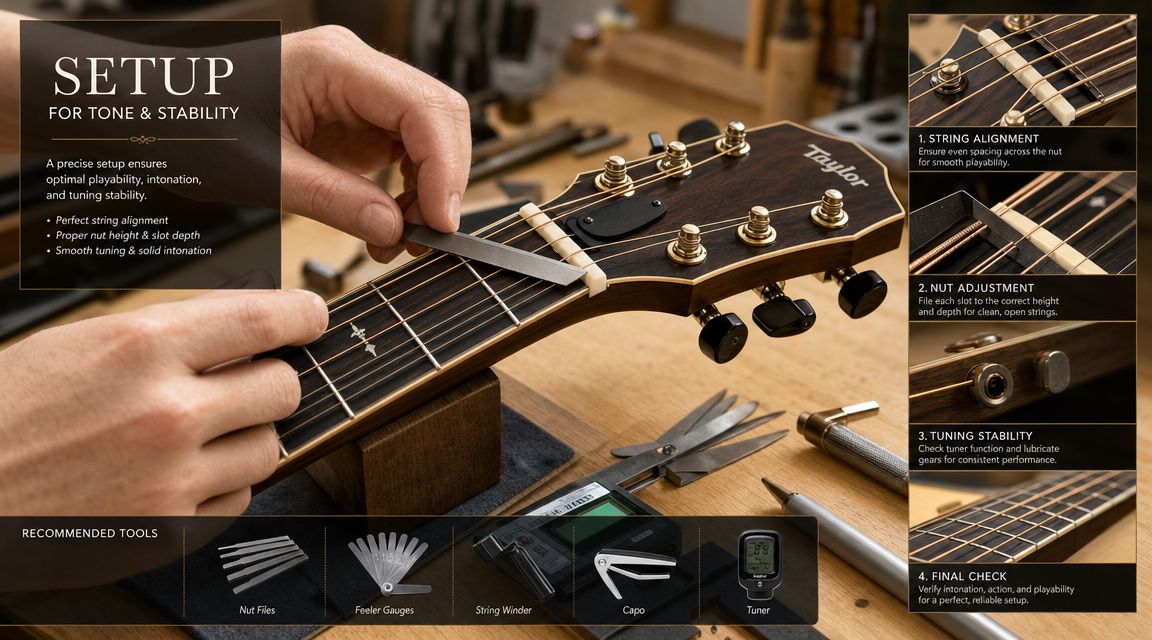
Strings affect more than tone
Players usually choose strings for sound first, but setup changes with string choice. Different gauges and tensions can change how stiff the instrument feels and how it responds under the pick. If you switch strings and the mandolin suddenly feels harder to fret or starts buzzing in new places, don’t assume your setup “went bad.” The string choice may have shifted the balance.
That’s why I like consistency during setup work. Pick one set you expect to use for a while, then dial the instrument in around it.
A few practical guidelines help:
- Stay consistent during setup work. Don’t measure action with one set and evaluate feel with another.
- Replace tired strings before diagnosing fine issues. Dead or kinked strings can imitate setup trouble.
- Restring neatly. Sloppy wraps cause drifting pitch and uneven settling.
Nut problems hide in plain sight
The nut controls how the strings leave the headstock and enter the playing area. If a slot is too tight, the string can bind and then jump during tuning. If a slot is too high, first-position notes feel harder than they should and may fret sharp from extra pressure.
You can spot warning signs without cutting anything:
| Symptom | What to suspect |
|---|---|
| String jumps in pitch while tuning | Binding in the nut slot |
| First-position chords feel unusually stiff | Nut slots may be too high |
| One course won’t return to pitch smoothly | Friction at nut or tuner |
A little graphite from a pencil can help lubricate a slot and reveal whether friction is part of the problem.
If a small amount of lubrication improves tuning, the nut is telling you something. Listen before you start filing.
When to leave the nut alone
Nut filing is one of the easiest setup jobs to do badly. Once material is gone, it’s gone. If the strings sit too low afterward, you’re into repair work, not setup.
That’s why I tell most players to inspect, lubricate, and diagnose the nut themselves, but to be cautious about cutting. If your mandolin clearly has high or poorly shaped slots, that’s often a smart place to hand the instrument to a luthier.
For players learning across multiple instruments and styles, the ArtistWorks school directory can also help you compare technique and maintenance habits across fretted instruments, especially if you come to mandolin from guitar, banjo, or ukulele.
Tuning stability is a whole-instrument issue
Stable tuning usually comes from several ordinary things done well:
- Clean string installation
- Smooth nut slots
- A stable bridge
- Good tuning habits
- Realistic expectations after restringing
When a mandolin won’t stay in tune, don’t blame the tuning machines first. The string path tells the story more often than the gears do.
Final Checks and Style-Specific Tips
The last stage is simple. Play the mandolin.
Not for ten seconds. Play first-position chords, melodies up the neck, double stops, tremolo, and the kind of rhythm you use. Setup only means something if it survives real playing.
A useful reminder from the earlier guidance is that setup isn’t a race to the lowest action. The better way to think about it is a balance between comfort and clean response. One source puts it plainly: if the action feels too stiff, lower the bridge; if you have string buzz, raise it from this mandolin setup discussion on YouTube. That’s a practical rule because it treats setup as an iterative compromise, not a trophy measurement.
What to listen for after the adjustments
Use a short checklist:
- Do chords in first position fret cleanly without extra force?
- Do upper-fret notes sound in tune relative to open strings?
- Does the mandolin buzz only when you attack hard, or even with a relaxed stroke?
- Does one course behave differently from the others?
Those answers help you sort setup issues from technique issues.
Knowing when to stop
There’s a point where further adjustment stops being productive. If you’re chasing one buzz around the neck, fighting inconsistent frets, or making repeated changes that only move the problem, stop.
That usually means one of three things:
- the issue is beyond basic setup
- the instrument needs fret or nut work
- your technique is part of what you’re hearing
None of that is failure. It’s good judgment.
A good mandolin setup guide should leave you with a playable instrument and a better ear for what the instrument is telling you. It should also make one thing clear. There isn’t one perfect setup for everybody. There’s the setup that suits your hands, your attack, and your music.
Ready to turn a better-playing mandolin into better music? Try an ArtistWorks 7-day free trial and study with master instructors at your own pace. If mandolin is your focus, start with the ArtistWorks Mandolin School.