
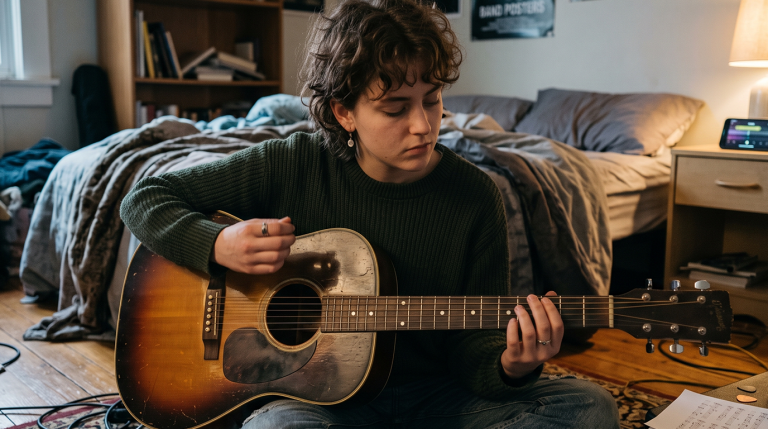
Free improvisation might be the most misunderstood concept in guitar education. Most players hear “free” and assume it means random, sloppy, or undisciplined. In fact, free improvisation is one of the most focused practices you can do. It strips away the safety net of scales and forces you to listen to what your instrument is actually saying. If you’ve been working through the five core approaches to improvising, this is the one that asks the deepest question: not “what scale fits here?” but “what effect do I want to create?” That shift changes everything.
This article will show you how to work without a scale map, how to treat every note as a valid choice. How to build a practice around something called tone painting that keeps your playing purposeful even when there are no rules.
What Free Improvisation Actually Means on Guitar
Free improvisation does not mean playing without thought. Instead, it means playing without a predetermined harmonic map. You are not tracking which scale degree you are on. You’re not checking whether a note fits the chord. You are listening to the sound coming out of your amp and asking one question: does this serve the feeling I’m going for?
That is a harder question than “is this note in the pentatonic box?” However, it is also a more honest one. When you remove the rule of scale correctness, you replace it with the rule of sonic intention. Every choice has to be deliberate, because nothing is automatically safe and nothing is automatically wrong.
This is not an advanced concept reserved for jazz players or experimental musicians. In fact, beginners sometimes take to it more easily than intermediate players. Intermediate players often carry a lot of anxiety about wrong notes. Because free improvisation reframes the whole question, that anxiety has nowhere to land.
Tone Painting: A Better Frame Than “Playing Free”
The phrase “free improvisation” can feel paralyzing, especially if you’ve spent years learning scales and positions. So here’s a more useful frame: tone painting. Think of your guitar as a brush and the sonic space as a canvas. Your job is not to play correctly. Your job is to paint a specific feeling.
For example, pick a single word before you start. Try “restless.” Now play anything, but make every note serve that feeling. Notice how quickly your choices sharpen. Suddenly you are choosing spiky rhythms, bends that don’t resolve, and dynamics that push rather than settle. That is free improvisation working the way it is supposed to work.
The word or image you choose becomes your compass. Because you have a compass, nothing is random. Even a “wrong” note can serve the painting if you respond to it with intention.
Get direct personal video feedback on your playing from Dave Isaacs at ArtistWorks!Start →
No Wrong Notes: Understanding the Real Stakes of Free Improvisation
Here is the idea that unlocks free improvisation for most players: every note creates a musical effect. Specifically, every note creates either tension, release, color, or some combination of all three. A note that clashes with the underlying harmony creates tension. That tension is not a mistake. It is a resource.
The question is not whether the note fits. The question is what you do next. If you hit a note that sounds jarring, you have two options. First, you can move away from it quickly and the tension resolves. Second, you can lean into it, let it sustain, and build on it. Both are valid. In fact, the second option is often more interesting.
This is the core skill of free improvisation: responding to what you just played rather than following a predetermined path. Using musical cells the right way builds a similar muscle. Cells are also about developing an idea in real time rather than running a scale from top to bottom.
Your Full Toolkit Goes Way Beyond Pitch
Most guitarists think improvisation is primarily about note choice. In free improvisation, pitch is just one ingredient. Rhythm, dynamics, texture, and even noise are equally valid materials. You can build an entire improvised moment out of a single repeated note if you vary the attack, the timing, and the pressure on the string.
Consider dynamics alone. A passage that starts barely audible and swells to full volume tells a story. That story exists even if every note is the same pitch. Similarly, rhythm can carry a mood independently of what notes you are playing. Locking into a groove with rhythm on a single note is a direct gateway into this kind of thinking.
Texture is also on the table. Percussive muting, pick scrapes, harmonics, and feedback are all sonic tools. In free improvisation, these are not cheats or gimmicks. They are colors on your palette, and you should use them when the painting calls for them.
Free Improvisation: Practical Steps to Start Playing with Intention
The fastest way to develop free improvisation is to give yourself a clear brief before each take. Pick a mood or a visual image, something specific like “abandoned building at dusk” or “a conversation that turns into an argument.” Then hit play on a simple backing track, anything with a steady pulse. Let your sonic choices serve that brief.
Do not monitor your scale use. Instead, monitor your feeling. After each pass, ask yourself one question: did that sound like what I was going for? If yes, notice what you did. If no, adjust one variable on the next take. Maybe the dynamics were too even. Maybe the rhythm was too predictable. Small adjustments add up fast.
Keep your takes short at first. Eight bars is enough. Building melodic lines one string at a time is a related technique that helps you stay focused when the harmonic map disappears. In addition, extracting melodic cells from a scale rather than running it gives you a bridge between structured and free playing.
Bringing Intention Back to Everything You Play
Free improvisation is not a detour from real guitar playing. It is, in fact, the destination that all structured practice is pointing toward. Once you understand that every note creates an effect and that your job is to shape those effects into a feeling, you will bring that awareness back to everything you play, including your blues licks, your chord melodies, and your solos over a standard backing track.
Return to the full beginner improvisation roadmap when you are ready to see how this approach connects to the other four. The five approaches work together. Free improvisation is the one that ties them all to your artistic voice. Start with a mood. Pick up the guitar. Paint something.
Learn guitar with Dave Isaacs at ArtistWorks!Start →
About the Education Team
Four music-industry veterans with decades of combined experience in music education, curation, and production at TrueFire and ArtistWorks. The TrueFire Studios Education Team plans and edits this content and works with our master-musician faculty to keep it accurate and genuinely useful.
Featured Contributor
A Nashville guitarist, songwriter, and veteran music educator, he’s known for teaching musicianship, confidence, and practical guitar skills. He performs across rock, blues, country, jazz, and folk styles, and is a Manhattan School of Music graduate and former university music instructor.
ⓘWhere AI Assists, and Where the Team Decides
We use AI tools to help with research synthesis and first-draft generation, guided by team-written outlines and our editorial standards. Every article is then reviewed, fact-checked, edited, and approved by a member of our education team before publication. AI does not make publication decisions, and no article publishes under a TrueFire byline without team sign-off. We disclose AI use on every article that uses it — here at the bottom of the blog, where you can see it, not buried in a policy page.