
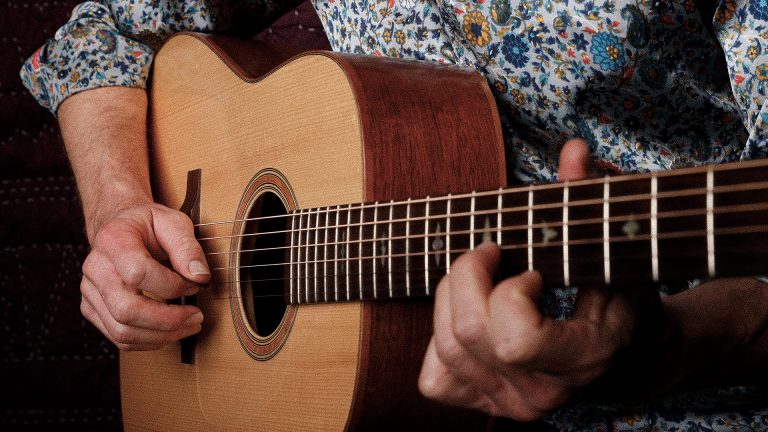
Bluegrass guitar asks you to do two things at once. You are the band’s rhythmic engine. You are also a lead voice stepping forward to carry the melody when your break arrives. That dual role confuses a lot of players, and most of the confusion lives in one bad habit: abandoning the melody the moment the spotlight hits. Understanding how bluegrass guitar balances these two jobs is the foundation of everything in the full ensemble improvisation guide.
This article breaks down the flatpicking approach specifically, from how you think about a break to how your pick hand generates the tone and drive that makes the whole band lock in. Work through the ideas here in order, because each one builds on the last.
What Bluegrass Guitar Actually Expects From You
First, let’s be clear about the role. In a bluegrass band, the guitar almost never stops contributing rhythmically. Even during a lead break, the best flatpickers maintain a sense of forward pulse. That pulse is what locks the bassist and mandolin together.
Second, you carry the melody when everyone else steps back. The band and the audience have already heard the song sung. Your break is essentially the vocal melody on strings. Because of that, listeners will feel it immediately if the melody disappears into scale fragments.
So the job is not “play rhythm, then play lead.” Instead, it is “play rhythm that hints at lead, then play lead that remembers rhythm.” That mindset shift changes everything about how you practice.
Start With the Melody, Not the Scale
The single biggest mistake in early-intermediate bluegrass breaks is reaching for the pentatonic box instead of the song’s actual melody. For example, if you are playing “Old Joe Clark,” the audience knows that melody. Your break should sound like “Old Joe Clark,” not like a G major scale workout.
Therefore, before you touch the guitar, sing or hum the melody slowly. Then find those notes on the fretboard, one phrase at a time. Keep them. Those are your skeleton notes.
Next, you can decorate. Add a slide into a long note. Drop in a hammer-on between two melody pitches. Use a pull-off to soften a phrase ending. However, do this only after the skeleton is solid. Decoration only works when the listener can still hear the bones underneath.
Additionally, land on the strong beats. The first and third beats of a measure are where the melody needs to be present. Fill the weak beats with ornaments or open strings, but do not bury a melody note in the middle of a run and expect it to register.
Learn with Grammy-nominee Michael Daves at ArtistWorksStart →
Bluegrass Guitar Tone Lives in Your Right Hand
Most players practice left-hand licks endlessly and wonder why their break sounds thin or mechanical. The answer is almost always the right hand. Specifically, it is pick angle, pick depth, and the way you release the string after you strike it.
Hold the pick firmly but not rigidly. Strike the string with a slight downward angle rather than perfectly parallel to the soundhole. This produces that bright, cutting tone you hear from players like Tony Rice or Clarence White. In contrast, a flat, parallel pick attack produces a softer, blurrier sound that gets lost in the mix.
Pick depth matters just as much. Shallow picking produces thin tone. Instead, let the pick travel through the string just far enough that you feel a slight resistance on the exit. That resistance is the string doing its job.
Furthermore, practice the right hand in isolation. Mute all six strings with your left hand, then run scales and licks with your right hand only. Listen to the evenness, the attack, and the drive. If the rhythm feels wobbly, slow down and fix it there before adding left-hand complexity.
Ornaments That Serve the Melody
Slides, hammer-ons, pull-offs, and crosspicking are the core ornament toolkit in bluegrass guitar. Each one should connect two melody notes or add vocal-style inflection, not replace the melody with technique.
Slides work especially well entering a note from a half-step below. For instance, if the melody lands on B, slide from Bb into B rather than attacking it directly. This mimics the way a vocalist bends into a pitch and gives the phrase a live, breathing quality.
Hammer-ons and pull-offs add grace note detail between skeleton notes. However, keep them short. One or two grace notes per phrase is usually enough. More than that and the melody gets cluttered.
Crosspicking is where bluegrass guitar gets its rolling, banjo-like texture. Specifically, it involves a repeating pattern across three adjacent strings in a steady eighth-note pulse. This technique references what banjo players build entire breaks around, and hearing both approaches side by side reveals a lot about how the style evolved.
Learn with Grammy & IBMA Award Winning Guitarist Bryan Sutton at ArtistWorksStart →
Bass Runs and Walk-Ups: Leading the Band’s Ear
During rhythm playing, the guitar’s most powerful tool is the bass run. A well-placed walk-up or walk-down between chords signals the next chord change to every player on stage. As a result, the whole band moves together rather than reacting to each other.
For example, moving from G to C, you can walk up G, A, B, and land on the bass note of C. This happens in the last beat before the change. Keep it simple and in time.
Bass runs also create momentum. They push the groove forward rather than sitting statically on each chord. In addition, they give the guitar a melodic contribution even during rhythm support, which is exactly the dual-role thinking this whole article is about.
Putting It Together: Backing Up Other Soloists
When someone else takes their break, your job shifts again. Now you are supportive texture, not a lead voice. Mandolin players depend on this, and learning how the chop and lead interact on mandolin will help you understand exactly what they need from you.
Keep your rhythm steady, your volume slightly below the soloist. Choose chord voicings higher up the neck when the break gets busy down low. This creates space in the sound rather than competition.
Furthermore, resist fill licks during another player’s break. Save your ideas for your own break. The best ensemble players know that restraint is a skill, not a limitation.
Your Next Step in the Ensemble Conversation
Bluegrass guitar is a conversation, not a solo instrument with accompanists. Every choice you make with your flatpick, whether on a bass run, a break, or a quiet backup strum, affects what every other player on stage can do. Returning to the full ensemble improvisation guide after working through this material will show you exactly how the guitar’s role connects to fiddle, bass, and banjo in real-time. Start slow, nail the melody skeleton, then add ornaments and drive. The band will feel the difference immediately.
Start learning with ArtistWorksStart →
About the Education Team
Four music-industry veterans with decades of combined experience in music education, curation, and production at TrueFire and ArtistWorks. The TrueFire Studios Education Team plans and edits this content and works with our master-musician faculty to keep it accurate and genuinely useful.
ⓘWhere AI Assists, and Where the Team Decides
We use AI tools to help with research synthesis and first-draft generation, guided by team-written outlines and our editorial standards. Every article is then reviewed, fact-checked, edited, and approved by a member of our education team before publication. AI does not make publication decisions, and no article publishes under a TrueFire byline without team sign-off. We disclose AI use on every article that uses it — here at the bottom of the blog, where you can see it, not buried in a policy page.