
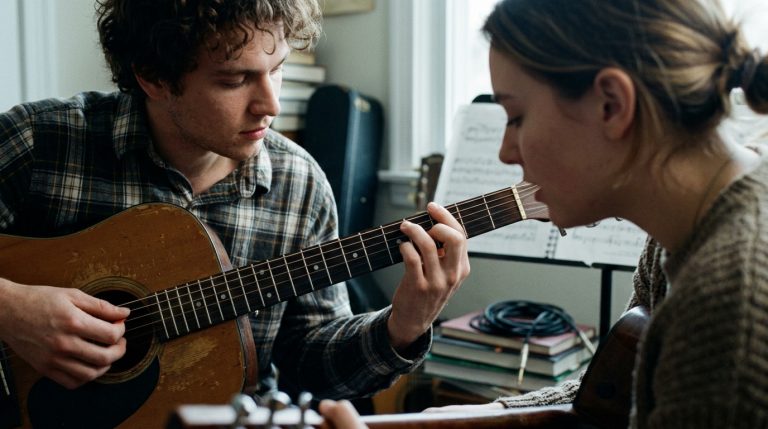
Arm posture is one of those things most players never consciously think about, until something starts to hurt, or a technique that should be simple refuses to click. You might be hitting the right notes and using a reasonable grip. But if each arm isn’t positioned to move freely, you’re working against yourself from the start.
This article focuses on the separate demands each arm places on your body. It explains why being mindful of your symmetry can set you up to avoid tension.
For the broader framework connecting posture across your whole body, the complete guide to comfortable guitar posture is worth reading first. Here, though, we’re zeroing in on what your arms actually need and why getting that right transforms how every technique feels.
Why Arm Posture Starts With the Guitar’s Natural Position
Before your arms can settle into a good position, you need an honest picture of where the guitar actually sits on your body. When seated, the instrument rests on your right leg and leans against your right side. It is not centered directly in front of you. That sounds obvious, but many players carry a mental image of the guitar as something centered and symmetrical, like a steering wheel. Because of that, they compensate by twisting their torso or pulling the neck inward. Both arms pay the price.
Dave Isaacs is a guitarist and educator who has spent years working with students on foundational issues like these. He frames the solution clearly. Let your arms drop naturally to your sides. Then bend from the elbows to bring them up, and meet the instrument at that neutral point. Instead of reshaping your arms around a fixed guitar position, you’re finding the position where the guitar meets your neutral arms. That single shift dissolves a lot of unnecessary muscular effort.
Dave Isaac’s Session Player Toolkit at ArtistWorks: a complete video curriculumStart →
Picking Hand Arm Posture: The Need for a Free Arc
Your picking or strumming hand needs a clear, unobstructed arc of motion. Because the guitar sits to your right side when seated, the picking arm is well-placed to swing freely from that angle. However, when players mentally try to center the guitar, the picking arm ends up angled awkwardly inward. That pinches at the elbow or shoulder. The result is a muted, weak attack rather than a clean, percussive one.
For strumming styles, keeping the guitar resting naturally to the right side gives your picking arm the most efficient path through the strings. Your forearm can rest lightly on the body of the guitar. Your wrist can hang in a relaxed curve. In contrast, an arm forced to work from an unnatural angle creates micro-tension. That tension shortens your endurance and muddies your tone. The tone of a strum is largely a product of how freely that arm can move. Arm posture is a direct tonal concern, not just a comfort one.
Fingerstyle and the Elevated Neck Position
Fingerstyle players often find that angling the neck upward slightly brings the picking hand into a better arc. You can achieve this by crossing your legs or using a footstool. That elevated neck position also opens space between the guitar body and the forearm. Fingerstyle technique frequently requires that clearance. So the picking hand’s needs can actually influence how you choose to seat the guitar in the first place.
Fretting Hand Arm Posture: Extending Out Rather Than Pulling In
The fretting hand tells a different story. Because the neck extends away from the body to the left, the fretting arm naturally reaches out in front of you. This is where arm posture becomes genuinely asymmetrical by design. Your fretting arm extends further forward than your picking arm. Many players respond to that reach by twisting their torso to the left. They’re trying to bring the neck closer. That twisting is the problem.
Instead, let the fretting arm extend. Your shoulder stays square and relaxed, and the arm reaches. The elbow should swing slightly forward and away from your body, not tucked in tight. When the elbow comes forward, the wrist naturally straightens. Then the fingers arch over the strings more cleanly. As a result, wider reaches across the neck become more manageable. You’re not fighting the geometry. You’re working with it.
This is also why shoulder posture and arm posture are closely linked. The moment your fretting shoulder begins to creep upward or forward in compensation, that tension travels down the arm. It tightens the hand. The fretting arm and the shoulder are essentially one continuous chain.
Standing Up: How Strap Height Governs Both Arms
When you stand, the guitar’s position is no longer determined by where it balances on your leg. Instead, your strap height controls everything. That makes strap height one of the most consequential arm posture decisions you can make. Extremes in either direction cause real problems.
Too low, and the picking wrist has to bend sharply upward to reach the strings. Meanwhile, the fretting wrist collapses into an angle that restricts your reach. That angle also strains the tendons over time. Too high, and the fretting elbow has nowhere to swing forward. It gets pinned against your body. In both cases, arm posture suffers because the instrument pulls both arms away from their natural resting angle.
Finding Your Neutral Strap Height
A practical approach: while standing, let your arms hang relaxed at your sides. Then bend both elbows, bringing your forearms up to a roughly horizontal position. Notice where your hands land in that neutral state. That’s approximately where the guitar’s body and neck should meet your hands when the strap is set correctly. It won’t look like the rock-star low sling. It may not look as formal as the classical seated position either. But it’s the position where both arms have the most freedom.
Dave Isaacs puts it simply: experiment with strap height while standing and pay attention to where your arms feel least effortful. That feeling is the signal. When both arms feel settled rather than strained, you’ve found your neutral. Return to it whenever something starts feeling off.
For related ideas about how your lower body supports all of this while standing, the article on how your feet influence your guitar posture is a useful companion. Additionally, keeping a balanced core while you play connects directly to how freely your arms can move without compensating through the torso.
Get personalized video coaching and feedback from Dave Isaacs at ArtistWorksStart →
Finding the Position Where Both Arms Can Do Their Jobs
Getting both arms in the right place isn’t about copying a look. Plenty of great players have unconventional postures that work beautifully for them. However, the underlying logic is consistent: each arm needs a neutral angle and room to move. No twisting, no pinching, no forcing a reach that isn’t there.
The asymmetry is intentional and useful. Once you accept that the picking arm and fretting arm operate in genuinely different spatial zones, you stop trying to impose a symmetry that was never there. Your picking arm swings freely from the right side. Your fretting arm extends out in front. The guitar sits where it naturally rests, not where you imagine it should be centered. For everything that ties this back into the full picture, the complete guide to guitar posture covers how arm position fits alongside neck, shoulder, core, and foot posture as a unified system. Start there, then come back here. After that, go experiment with your strap height or seating position. You’ll hear and feel the difference quickly.
Learn guitar with Dave Isaacs at ArtistWorks – Try a 7 day free trial!Start →
About the Education Team
Four music-industry veterans with decades of combined experience in music education, curation, and production at TrueFire and ArtistWorks. The TrueFire Studios Education Team plans and edits this content and works with our master-musician faculty to keep it accurate and genuinely useful.
Featured Contributor
A Nashville guitarist, songwriter, and veteran music educator, he’s known for teaching musicianship, confidence, and practical guitar skills. He performs across rock, blues, country, jazz, and folk styles, and is a Manhattan School of Music graduate and former university music instructor.