
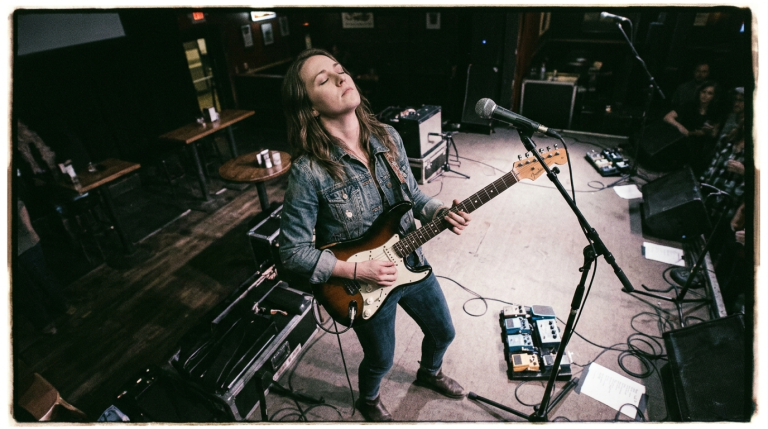
Foot posture is the part of the guitar setup conversation that almost never happens. Players spend real time thinking about neck angle, shoulder tension, and arm position. Yet the foundation, literally the ground beneath you, gets ignored. That is a problem. Everything above your feet depends on what your feet are doing. Whether you are seated or standing, your foundation determines how locked or how free the rest of your body can be.
This article looks at why foot posture matters in both contexts. It gives you a practical way to locate your natural balanced position before you play a note. It also explains how a quick floor-level check at the start of every session sets up every other part of your posture. For a full picture of how this fits into your overall setup, start with the complete guitar posture guide.
Foot Posture Is Your Foundation, Not an Afterthought
Think about what posture actually is. It is a chain. Your hands connect to your arms. Your arms connect to your shoulders. Your shoulders connect to your spine. Your spine connects to your hips. And your hips connect to your feet. Break the chain anywhere and the stress redistributes upward. Most guitarists try to fix that stress at the shoulder or the wrist. That is like fixing a wobbling table by sanding the top instead of leveling the legs.
Foot posture is the leveling of the legs. Because it is invisible while you play, it rarely gets addressed. That invisibility is exactly why it deserves deliberate attention.
What Foot Posture Looks Like When You Are Seated
Seated playing has a clear best-practice for the lower body. Both feet flat on the floor, weight distributed evenly through the seat bones and through the soles of both feet. That combination anchors the lower body. It makes the balanced, slightly-forward-of-center seated position sustainable over a long practice session, rather than something you have to consciously maintain.
When one foot gets tucked under the chair, the pelvis tilts. The same thing happens when the feet are crossed at the ankle or lifted off the floor entirely. A tilted pelvis shifts the lumbar spine. That shift travels upward. The player then tries to compensate at the shoulder or the neck and wonders why things feel tight. In most cases, the answer is on the floor.
Also worth noting: a footstool under one foot is a common classical setup. It is a deliberate break from flat-floor positioning and a tool for a specific purpose. If you are not using it intentionally, it is just asymmetry looking for somewhere to create tension.
Dave Isaac’s Session Player Toolkit at ArtistWorks: a complete video curriculumStart →
The Standing Context: Balance as a Feature, Not a Challenge
Standing is, in one sense, harder. You are actively balancing your whole body weight. However, that active balancing is also what makes standing feel looser for many players. The subtle, ongoing micro-adjustments your legs and feet make keep the whole body slightly in motion. As a result, nothing gets rigidly locked the way it can in a sustained seated position.
Your feet need to be set up to support that dynamic balance, not fight it. Feet planted too close together create a narrow base. Therefore, small shifts in weight feel dramatic and destabilizing. Feet too far apart lock the hips. The goal is a shoulder-width stance, weight balanced evenly between both feet, knees easy rather than locked.
Dave Isaacs, an educator with deep experience in guitar technique and performance, emphasizes that a relaxed, grounded foundation frees the upper body to respond to the music. Without that foundation, the upper body is managing instability instead. That idea starts at the floor.
The Weight-Shift Exercise: Finding Center Before You Play
Here is a practical technique worth making a habit. Before you pick up the guitar, stand with your feet roughly shoulder-width apart and your arms relaxed at your sides. Slowly shift your weight toward one foot, then back through center, then toward the other. Let the movement be obvious at first. Then gradually narrow the range. Eventually, settle where the movement becomes neutral and the effort disappears. That spot is your natural center of balance.
Pick up the guitar from that position. Notice how the instrument settles differently against a body that is already grounded. In contrast, most players pick up the guitar first and then try to find their balance around it. Reversing the order is a small change with a noticeable effect.
This same principle applies when you check your core stability and balance. The core can only do its job when the foundation beneath it is stable.
The Strap Connection: How Foot Posture Changes When You Use One
A strap does something useful even when you are seated. Because the strap is supporting part of the instrument’s weight, your legs and lap are no longer load-bearing surfaces for the guitar. That frees you to adjust your leg position for comfort rather than locking it into whatever position best cradles the body of the instrument.
For players who find seated posture uncomfortable, adding a strap while seated opens up options. You can shift how your weight sits, reposition a foot, or change the angle of your knee. In each case, foot posture remains relevant. Because your legs are free to move, the temptation is to let them drift into whatever feels easy. Deliberate foot placement keeps you anchored even when the strap takes over support of the instrument.
The “Rock Before You Rock” Principle
Here is a simple test of good foot posture. Stand or sit in your playing position. Without adjusting anything, can you shift your weight a few inches in any direction and return to neutral without effort? If yes, your foundation is working. If a small shift throws off your whole setup, something is locked that should not be locked.
Good foot posture does not mean standing or sitting like a statue. Instead, it means being so well-grounded that your body can move dynamically with the music. You should be able to return easily to a neutral position at any moment. Dave Isaacs puts it simply: a player who is truly relaxed can move. A player who is compensating for a bad foundation is always managing, never free.
That freedom is worth chasing. You can see how arm and shoulder mobility also depend on this kind of baseline stability by checking out how arm posture affects your technique.
Get personalized video coaching and feedback from Dave Isaacs at ArtistWorksStart →
Make the Floor Check the First Step of Every Practice Session
Ten seconds. That is all a floor check takes. Before you pick up the guitar, notice what your feet are doing. Stand, run the weight-shift exercise, find center, and then reach for the instrument. Or sit, place both feet flat, feel the weight distribute evenly, and then adjust everything above.
This habit compounds quickly. In addition, it prevents the kind of session where you spend the first twenty minutes slowly accumulating tension without knowing why. By the time tension reaches your hands, it has usually been building from the ground up for a while.
For everything above the floor, visit the full posture overview or dig into neck position and its downstream effects and shoulder tension specifically. Good posture is a system. Foot posture is simply where the system begins.
Learn guitar with Dave Isaacs at ArtistWorks – Try a 7 day free trial!Start →
About the Education Team
Four music-industry veterans with decades of combined experience in music education, curation, and production at TrueFire and ArtistWorks. The TrueFire Studios Education Team plans and edits this content and works with our master-musician faculty to keep it accurate and genuinely useful.
Featured Contributor
A Nashville guitarist, songwriter, and veteran music educator. He’s known for teaching musicianship, confidence, and practical guitar skills. He performs across rock, blues, country, jazz, and folk styles, and is a Manhattan School of Music graduate and former university music instructor.