
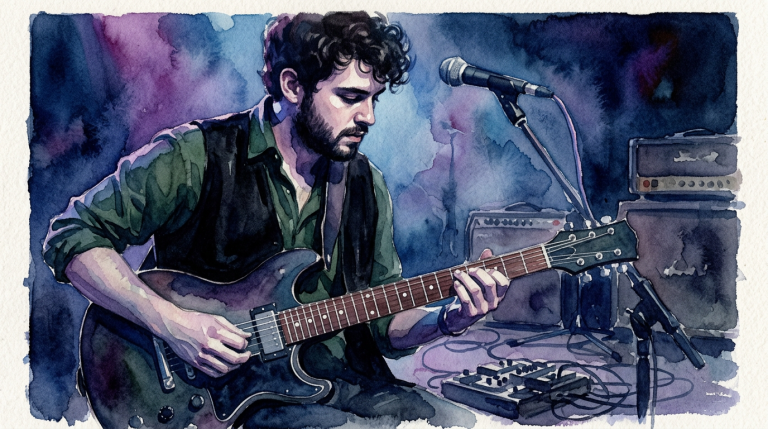
Core posture is the missing piece in most conversations about guitar technique. Players spend real time thinking about their shoulders, their wrists, their picking angle, all legitimate concerns. But the hips and core sit underneath all of that, and when that foundation is unstable, everything above it pays the price.
This article is about that foundation: what core posture does, why it breaks down. How to rebuild it so your upper body has nothing to fight against. For the full picture of how this fits into your playing, the complete guide to guitar posture is a good place to start. But if your hands feel tight and you can’t figure out why, core posture is where to look first.
Why Core Posture Is the Real Source of Upper-Body Tension
Most guitarists think of posture as a shoulders-and-back issue. That framing isn’t wrong, but it’s incomplete. The spine doesn’t float in space. It rises out of the pelvis, and the pelvis sits on whatever is supporting it. When your core posture is poor, whether from an unengaged core or hips tilted forward or slumped backward, the spine has no stable base to rise from. So the upper body compensates. It braces itself. That bracing is exactly the tension you feel in your forearms, your shoulders, and eventually your hands.
The mechanism is straightforward. A collapsed lower back changes the angle of your arms relative to the guitar. Your muscles then work harder just to hold a position that should require almost no effort. You might adjust your grip, raise your shoulder, or crane your neck forward, all trying to solve a problem that actually lives several inches lower. Understanding core posture means recognizing that tension rarely starts where you feel it.
Dave Isaacs, a TrueFire educator with decades of experience teaching technique and body mechanics, puts a lot of focus on this exact issue. He consistently points players toward the base of the spine rather than the hands when they report tightness or fatigue.
Dave Isaac’s Session Player Toolkit at ArtistWorks: a complete video curriculumStart →
The Sitting Trap: What Leaning Back Does to Your Core Posture
Sitting looks passive. For most of us, leaning back into a chair feels like relaxing. In practice, however, leaning back collapses the lower back and lets the spine sag. The curve of the lumbar region flattens or even reverses. As a result, the upper back rounds forward to compensate, the shoulders roll in, and your arms are now working uphill.
The fix is simpler than it sounds. Shift forward to the edge of the seat. Let your feet land flat on the floor. Feel what happens. Your weight now distributes between your seat and your feet, and the spine naturally finds a more upright position without any conscious effort to “sit up straight.” That’s the point: good seated core posture shouldn’t feel like work.
There’s also a bonus that most players don’t expect. In this position, you can actually move with the music. You can rock slightly, shift weight, express the rhythm physically. That freedom is both expressive and diagnostic. If you feel locked in place, that’s a sign something is still bracing. A genuinely relaxed, centered position allows natural movement rather than restricting it.
Standing With Your Hips, Not Your Upper Back
Standing introduces a different challenge. When you strap on a guitar and stand, the temptation is to twist from the upper back to adjust your playing angle. In contrast, the movement should come from the hips. Hips centered over your legs create a stable, grounded platform. Moving from that center keeps the entire mechanism free.
Try this as a simple reset. Stand with your guitar and sway gently side to side, shifting your weight from foot to foot. Slowly reduce the size of the movement. Eventually, you’ll land at a point where you feel equally balanced and the swaying naturally stops. That’s your home base. Notice how little effort it takes to stand there. Notice, too, that your upper body hasn’t had to do anything except ride along.
For more on how the lower body supports all of this from the ground up, the piece on why your feet matter more than you think covers the standing foundation in depth.
The Over-Correction Trap: Rigid Core Posture Is Still Bad Posture
Here’s the catch. When people hear “engage your core” or “sit up straight,” they often snap into a stiff, military-straight position. That is just a different kind of tension. Your spine has a natural curve. Your muscles are meant to work with that curve, not flatten it. Locking yourself into rigid alignment is exhausting and counterproductive.
The goal is balanced and easy, not braced and locked. Think of it as finding a position where your muscles have just enough engagement to keep you upright, and no more. Your core posture should support the spine the way a good chair supports a sitter: present, but not intrusive. When you find that, you’ll notice your breathing deepens, your shoulders drop. Your hands feel more connected to what they’re doing.
Dave Isaacs emphasizes this distinction consistently. The body’s natural resting alignment, when you’re not fighting against bad habits, is already close to correct. The job is to stop interfering with it.
Practical Core Posture: Two Simple Resets
You don’t need a yoga mat or a posture coach. These two resets take about thirty seconds each.
Seated reset: Sit on the edge of your chair. Put both feet flat on the floor. Feel the weight spread between your feet and your seat. Don’t try to sit up straight. Instead, just let the spine find its position with that weight distribution beneath it. That’s it. Notice how your arms feel now compared to before.
Standing reset: Sway gently from side to side, shifting weight foot to foot. Slowly shrink the movement until you settle at center. Take a breath. That’s your balanced standing base. Everything above the hips should feel easy.
Both of these resets connect directly to what’s covered in the complete guitar posture guide. They also work as a starting point before you think about your shoulders or your arm position. Those adjustments tend to fall into place more naturally once the base is right.
Core Posture as the Foundation for Everything Else
A grounded, centered core posture isn’t about perfection. It’s about creating conditions where your upper body has nothing to fight against. When the hips are stable and the spine rises naturally from that base, your arms move more freely and your hands relax more easily. Your neck isn’t craning forward to compensate for a slouch you didn’t know you had.
For context on how this connects upward to your neck and head position, the article on why looking down is holding you back is worth reading next. And if you want the full framework in one place, the complete guitar posture guide ties all five principles together. Start with the base. The rest follows.
Learn guitar with Dave Isaacs at ArtistWorks – Try a 7 day free trial!Start →
About the Education Team
Four music-industry veterans with decades of combined experience in music education, curation, and production at TrueFire and ArtistWorks. The TrueFire Studios Education Team plans and edits this content and works with our master-musician faculty to keep it accurate and genuinely useful.
Featured Contributor
A Nashville guitarist, songwriter, and veteran music educator. He’s known for teaching musicianship, confidence, and practical guitar skills. He performs across rock, blues, country, jazz, and folk styles, and is a Manhattan School of Music graduate and former university music instructor.