
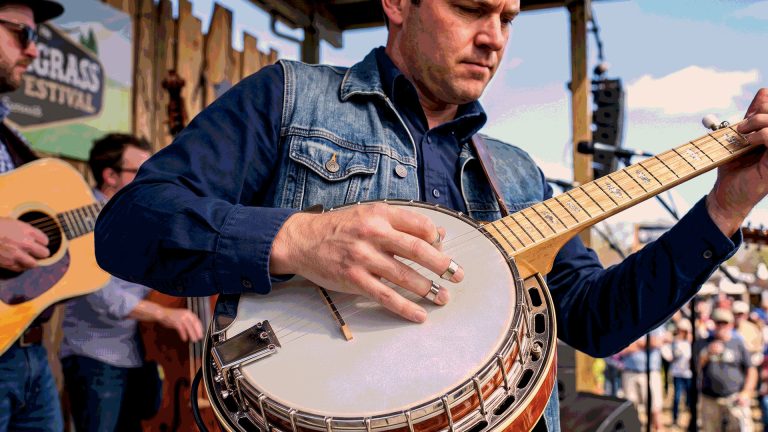
Bluegrass banjo is almost alone among improvising instruments in that the picking hand never fully stops. Three-finger rolls create constant motion whether you are playing a bluegrass banjo break or sitting in the background. That single fact changes everything about how you approach a bluegrass banjo solo. On guitar or fiddle, improvising means deciding what to play and when to play it. On banjo, the roll is already happening. Your job is to shape it, emphasize the right moments. Let the melody rise to the surface rather than drown inside the pattern. If you have ever wondered why your breaks feel busy without quite saying anything, this is the issue to solve. For a broader picture of how each instrument contributes to the group conversation, start with the full ensemble improvisation guide before diving in here.
The Roll Problem Every Bluegrass Banjo Player Faces
The three-finger roll is not just a technique. It is the engine. Because it runs almost continuously, it creates a wall of sixteenth notes that can blur together into pure texture if you are not careful. Many early-intermediate players sound busy but unclear. The notes are there, but no single note stands out enough to carry the melody.
Understanding this problem is the first step toward solving it. In other words, the roll does not need to change. What needs to change is which notes inside the roll get emphasis. The right hand stays busy. The left hand, the pick attack, and your choice of fingering decide which notes the listener actually hears.
Learn with Grammy Winner Alison Brown at ArtistWorksStart →
Melody on the Strong Beats: Where the Notes That Matter Live
Think of the roll as a frame. The melody notes live on the downbeats and the strong eighth-note positions inside each measure. Your goal is to land the correct pitch on that strong beat and let the roll fill the space around it naturally.
For example, take a simple G major melody. Identify the note that belongs on beat one. Now build your roll so that note falls at the top of the pattern. Everything else becomes support. This approach requires knowing your melody note by note before you improvise, even loosely. That is not a limitation. Instead, it is the foundation that makes the roll sound musical rather than mechanical.
Melodic-style banjo takes this idea to its extreme, where every melody note falls in sequence across strings almost exactly as it would in a single-note guitar line. However, straight melodic playing is only one side of the coin.
Two Approaches: Melodic Style Versus Drive-Forward Playing
In bluegrass banjo improvisation, you have two distinct modes available. First, melodic style places every melody note precisely in the correct rhythmic position. It sounds note-for-note accurate and works especially well on slower tempos or tunes with long, singable lines.
Second, drive-forward playing prioritizes the roll’s forward energy. You hit the important melody notes but allow the roll to push through the less critical beats. The melody is implied rather than stated exactly. As a result, the break feels powerful and rhythmic rather than delicate.
Knowing when to use each approach is the real skill. For instance, a slow ballad calls for melodic clarity. A hard-driving fiddle tune at full speed calls for roll-forward energy. Most breaks blend both. You start with melodic precision on the opening phrase, then shift into roll-forward drive as intensity builds.
The Cry: Left-Hand Tools That Give a Break Emotional Weight
Notes alone do not make a break feel alive. Slides, chokes (string bends), and hammer-ons are the left-hand tools that give bluegrass banjo improvisation its emotional signature. These are not decorations. They are the vocabulary that makes the instrument cry.
A slide into a melody note creates anticipation. A choke at the top of a phrase creates tension before the release. A hammer-on adds a small rhythmic push that makes the roll feel like it is breathing. These techniques work because they change the shape of the note, not just the pitch.
The key is placement. Use a slide or choke on a melodically important note, not on every note. Overuse flattens the emotional arc. Instead, save these tools for the moments that need weight, specifically the note that resolves a phrase or lands on the root at the end of a turnaround.
Bluegrass Banjo: Moving Up the Neck Across a Full Break
One of the clearest ways to arc a solo from subtle to powerful is to move up the neck as the break progresses. The lower positions on a banjo are warm and grounded. The higher positions are bright and cutting. Starting low and moving up gives the listener a sense of arrival.
This works in bluegrass banjo because the same chord shapes exist across multiple positions. Therefore, you can begin a break in open position, shift to a partial barre shape around the fifth fret. Then push further up for the final phrase. Each register shift adds intensity without increasing volume. Of course, volume can increase too. Position changes give you an additional layer of control that volume alone cannot provide.
Practice this arc deliberately. Play a simple 16-bar break and force yourself to change positions at bar 9 and again at bar 13. Notice how the momentum builds even if the note choices stay simple.
Learn with Grammy-nominee and IBMA Award Winner Tony Trischka at ArtistWorksStart →
Backing Up Gracefully: Keeping the Banjo Out of the Way
A full break is only part of the job. Between breaks, the banjo needs to back up without bulldozing the fiddle or the bass. This is where vamping becomes essential. A vamp is a quieter, more transparent roll pattern that sits in the texture rather than on top of it.
For a deeper look at how the whole band navigates space between solos, the piece on upright bass improvisation and restraint covers the same principle from the low end. Similarly, how the mandolin chop creates room for other instruments shows how that midrange instrument approaches the same challenge from a rhythmic angle.
Pull back your pick attack, avoid the high strings during someone else’s break, and let the rhythm breathe. The banjo has a naturally bright, penetrating sound. Because of that, a little volume reduction goes a long way.
Bluegrass Banjo: Applying the Melody-First Framework to a Real Break
Now bring it all together. Pick a tune you know well. Sing or hum the melody before you play it. Identify the three or four notes in each phrase that carry the most meaning. Then build your roll so those notes land on strong beats.
Add one slide, one hammer-on, and one choke across the break. Shift positions once, in the second half. Back off the volume on the last few bars and let the fiddle or guitar re-enter cleanly. That is a complete, shaped break. It draws on everything that makes bluegrass banjo improvisation distinct from every other instrument in the band.
For the full picture of how your banjo break fits into the ensemble conversation, return to the player’s guide to all five instruments improvising together. And if you want to hear how the approach translates to the flatpicked guitar side of the band, the guide to melody-first guitar breaks covers the same melody-before-decoration philosophy from a different angle.
Start learning with ArtistWorksStart →
About the Education Team
Four music-industry veterans with decades of combined experience in music education, curation, and production at TrueFire and ArtistWorks. The TrueFire Studios Education Team plans and edits this content and works with our master-musician faculty to keep it accurate and genuinely useful.
ⓘWhere AI Assists, and Where the Team Decides
We use AI tools to help with research synthesis and first-draft generation, guided by team-written outlines and our editorial standards. Every article is then reviewed, fact-checked, edited, and approved by a member of our education team before publication. AI does not make publication decisions, and no article publishes under a TrueFire byline without team sign-off. We disclose AI use on every article that uses it — here at the bottom of the blog, where you can see it, not buried in a policy page.