
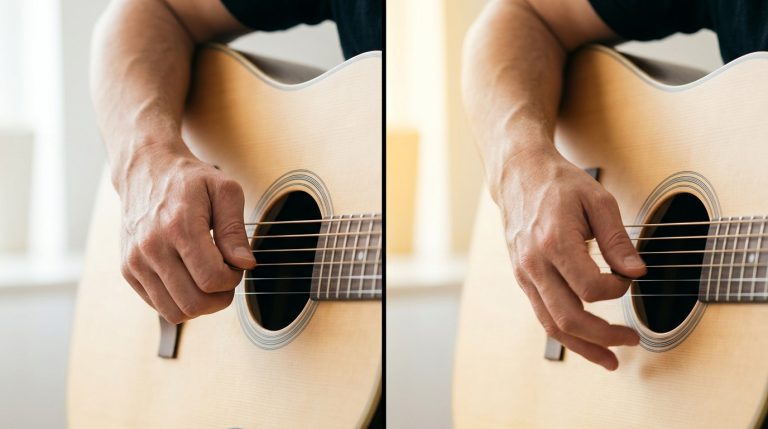
Your strumming arm is supposed to swing freely, but something goes wrong the moment you try to play a chord. Suddenly the arm stiffens, the rhythm feels mechanical, and the whole experience turns into a chore. If you’ve ever described your strumming as “pumping water” or “sawing a board,” you’re not alone. That stiff, effortful feeling is one of the most common physical blocks guitarists face.
Fortunately, it almost always comes from one fixable habit: the arm stops moving through its full arc and locks up instead. In this post, we’ll get into exactly what causes that lockup and, more importantly, how to let the arm swing the way it naturally wants to. If you want the bigger picture on habits that stall your progress, start with the five self-sabotaging habits every guitarist should know.
What a Locked Strumming Arm Actually Feels Like
First, let’s name the sensation precisely. A locked strumming arm feels like effort on every single stroke. Down, stop. Up, stop. Down, stop. Each stroke is its own separate event. As a result, the rhythm sounds choppy and tense, because it is. You’re not playing one continuous motion; instead, you’re playing a series of small jerks.
The trouble usually starts with the upstroke. Most players let the arm fall downward reasonably well. However, on the way back up, the bicep grabs and yanks the forearm back to the starting position. That yank is the lockup. Because the arm is fighting itself, tension travels up through the elbow and into the shoulder. In short, the whole limb becomes a rigid lever instead of a loose pendulum.
The Hidden Geometry of Your Strumming Arm
Here is the part most instruction skips entirely. The strumming arm does not move in a flat, straight line parallel to the guitar face. Instead, it naturally moves in a gentle three-dimensional arc, almost like a small wheel rolling around a pivot near the elbow. When you let the arm fall freely from the shoulder and elbow, it traces a slight curve outward and back. That arc is what the arm wants to do.
For example, hold your strumming arm out in front of you with no guitar. Shake your wrist loosely, then let the motion travel up into the forearm. Notice that the arm sweeps through a small arc rather than pumping straight up and down. That is the natural movement. Therefore, when you force a straight up-and-down pump against that arc, you are working against your own anatomy. No wonder it feels stiff.
Why the Upstroke Is Not a Separate Move
This is the key idea to understand. Most players think of the downstroke and the upstroke as two different actions. In contrast, they are actually one connected movement: the downstroke is the swing. The upstroke is simply the return to the top of that swing. Think of a clock pendulum. The pendulum doesn’t stop at the bottom and then decide to come back up. Instead, the momentum of the downswing carries it right back through. Your strumming arm works the same way.
Because the upstroke is the return portion of a single arc, it should cost almost no extra muscular effort. When it does feel effortful, that is a sign that the arm stopped mid-swing and the bicep re-engaged to haul it back up. So the fix is not to “do” the upstroke more deliberately. Instead, simply let the downswing continue past the strings and carry the arm back through its arc naturally.
A Simple Drill to Find the Free Swing
Try this before you touch a chord. Let your strumming arm hang loosely at your side. Then, gently swing the forearm back and forth from the elbow, as if you are shaking water off your fingers. Notice that the motion feels almost effortless. Now bring that arm up to guitar position and let the same swing happen across the strings. Don’t aim for the strings. Instead, let the arc pass through them.
At first, mute all the strings with your fretting hand so you can focus entirely on the strumming arm. Count a slow four-beat pulse out loud. Then let the arm swing down on one and return on the “and.” Keep the wrist relaxed. As a result, you will probably notice the sound getting fuller and more consistent, even though you are trying less hard. That is the arm working with physics instead of against it.
How Tension Travels Up from the Wrist
One more thing is worth noting here. A stiff wrist will freeze the strumming arm even when the elbow and shoulder are relaxed. However, the reverse is also true: a rigid upper arm creates a stiff wrist. The whole limb is one connected system. For this reason, don’t isolate the wrist when you troubleshoot. Instead, start from the shoulder, let it drop, then let the elbow soften, and finally let the wrist follow. Release from the top down.
This connects to a broader conversation about body awareness that this piece on “body blindness” and guitar technique covers in depth. In addition, if your fretting hand is gripping the neck too hard, that tension often mirrors itself in the strumming arm. You can explore that pattern further in this guide on why neck tension kills your fret hand technique.
When the Strumming Arm Feels Natural, Everything Changes
Here’s how you know the strumming arm is finally free: strumming feels like shaking someone’s hand. It feels almost too easy. The rhythm comes out more evenly, the tone opens up, and you stop thinking about the physical act because it no longer demands attention. That is the goal. Strumming should fade into the background so your musical brain can focus on feel, groove, and expression.
Finally, give yourself permission to move slowly. A free swing at 60 BPM is worth far more than a locked pump at 120 BPM. Gradually increase the tempo only after the looseness is stable. Eventually, the free arc becomes automatic, and the whole experience of rhythm guitar changes. For a broader look at all the physical and mental habits that hold players back, return to the full guide on clearing the blocks that stall guitar progress. The strumming arm is just one piece of the puzzle, but freeing it up unlocks a surprising amount of everything else.
Take your chops to the next level with ArtistWorks!Start →
About the Education Team
Four music-industry veterans with decades of combined experience in music education, curation, and production at TrueFire and ArtistWorks. The TrueFire Studios Education Team plans and edits this content and works with our master-musician faculty to keep it accurate and genuinely useful.
Featured Contributor
A Nashville guitarist, songwriter, and veteran music educator, he’s known for teaching musicianship, confidence, and practical guitar skills. He performs across rock, blues, country, jazz, and folk styles, and is a Manhattan School of Music graduate and former university music instructor.
ⓘWhere AI Assists, and Where the Team Decides
We use AI tools to help with research synthesis and first-draft generation, guided by team-written outlines and our editorial standards. Every article is then reviewed, fact-checked, edited, and approved by a member of our education team before publication. AI does not make publication decisions, and no article publishes under a TrueFire byline without team sign-off. We disclose AI use on every article that uses it — here at the bottom of the blog, where you can see it, not buried in a policy page.