
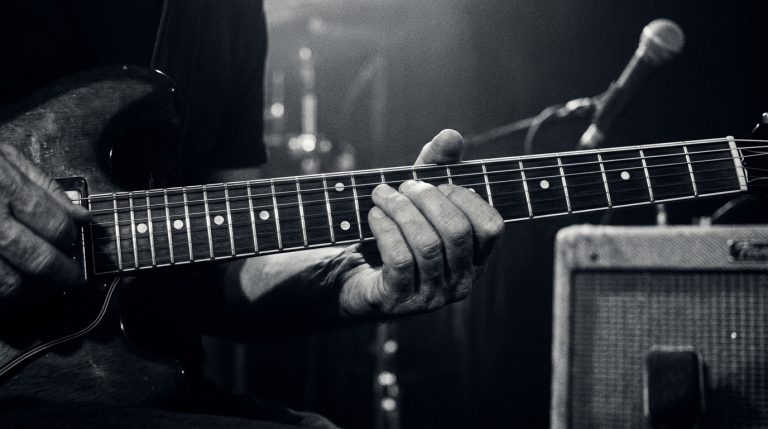
Big guitar tone is not a volume knob problem. Watch Albert King fill a gymnasium with a single bent note, or B.B. King silence a crowd with one slow vibrato, and something becomes obvious: the size of the sound is coming from their hands. It is not coming from a louder amp or a fancier pedal.
This article unpacks exactly what those hands are doing, because most players leave that dynamic range sitting on the table. If you have been chasing a room-filling blues sound, this is the framework that ties it all together. Here, we go deeper on the one part that surprises most students: the hands themselves are the tone generator.
What the Kings Were Actually Doing Up There
Albert King, B.B. King, Freddy King, and Buddy Guy all shared one observable habit. They played with enormous physical commitment. Every note had weight behind it. That weight was not accidental bravado. It was deliberate control over how hard the pick contacted the string, how much flesh muted the neighboring strings. How the vibrato was shaped after the note spoke. In short, it was technique acting as a volume control at the source.
Most players trying to sound like these legends reach for the volume knob first. That is understandable. However, turning up does not add dynamics. Instead, it flattens them. A loud amp makes everything sound roughly the same size. The legends sounded huge because they created contrast, and contrast requires control.
Why Big Guitar Tone Starts in the Fretting Hand
The fretting hand does more than press notes. It decides which strings ring and which strings die. That choice shapes everything the listener hears. When extra strings ring accidentally, the sound gets cluttered and small. When unwanted strings are silenced, the notes that do ring feel enormous in comparison.
B.B. King was a master of this. He rarely played chords. Instead, he used single notes surrounded by near-silence. That silence made his notes pop forward in the mix. His fretting-hand muting kept the sonic space clean. In other words, he was editing the sound at the source before it ever reached the amp.
Additionally, the fretting hand controls vibrato, and vibrato controls perceived volume. A wide, slow vibrato from Albert King could make a note swell into the room. A tight, controlled vibrato from B.B. kept tension without sacrificing pitch. Both are fretting-hand skills, and both contribute directly to big guitar tone.
Video Exchange with Keith – send him videos, get videos back with direct coachingStart →
The Picking Hand Is Your Real Volume Knob
If the fretting hand is the editor, the picking hand is the engine. Pick attack is the single biggest factor in how large a note sounds in real time. A pick that drags through the string slowly produces a warm, round sound. A pick that snaps through quickly produces a bright, aggressive spike. Buddy Guy used both on the same note, sometimes starting gentle and then digging in mid-phrase.
Therefore, the first thing to examine in your own playing is how you are holding the pick. A death grip transfers tension into the attack and makes dynamics inconsistent. A relaxed grip lets the pick respond like a shock absorber. As a result, the dynamic range between a gentle passage and a hard attack becomes much wider.
Also, the angle of the pick matters. A flat pick attack gives maximum surface area against the string and creates a thicker sound. Slightly rotating the pick so the edge leads produces a brighter, more cutting attack. Experimenting with both is one of the fastest ways to expand your tonal vocabulary without touching a single knob.
Muting and Attack Work Together, Not Separately
Here is where it gets specific. Big guitar tone is not just about a great fretting hand or a great picking hand in isolation. It is the combination. Precise muting from the fretting hand clears space. Then a deliberate pick attack from the picking hand fills that space with exactly as much or as little volume as the phrase needs.
For example, in a shuffle pattern, you are moving between bass notes and chord fragments. If the bass notes ring into the chord fragments, the rhythm gets muddy. However, if you control which strings ring at each moment, the shuffle breathes.
The specifics of thumb muting and the right picking motion for a shuffle pattern are worth studying closely. That is where the theory becomes tangible movement in the hands.
This is also why the “super shuffle” concept is not just a shuffle technique. It is a general principle. The same muting and dynamic control that creates a clean, powerful shuffle also works in slow blues, fast boogies, and chord-melody playing. The technique scales across every situation you will encounter.
Keith Wyatt teaches blues guitar lessons for all level of playersStart →
Practicing the Hand Partnership at Home
The gap for most students is simple: they have never practiced muting and attack together deliberately. They have practiced notes. They have practiced scales. However, they have not specifically drilled what happens in the gap between notes.
Start with a single note. Play it softly, then play it hard, using the same fingering and the same string. Notice what your pick hand does differently. Next, mute the adjacent strings before picking, and notice how much cleaner the loud attack sounds without extra string noise blurring the edges. Then do it again, this time muting with both hands coordinated. That coordination is the skill.
In addition, record yourself. A short phone recording is honest in a way that live playing is not. You will often hear extra string noise, inconsistent attack, or vibrato that fades too soon. These are all solvable problems. Filling out the groove with triplet fills and pull-off licks becomes much more achievable once the foundation of clean, dynamic single notes is in place.
Bringing It Together for a Room-Filling Sound
Turning up is the easy answer. Technique is the one that actually works. The blues legends understood that because they had to play in rooms with inconsistent PA systems and minimal monitoring. They could not rely on the gear. So they developed hands that did the work.
Return to the full super shuffle framework after working through these hand fundamentals. You will hear it differently. The techniques there will make more sense physically, because you will understand that the goal was never volume. The goal was always control, and control is what makes a guitar sound truly big in any room.
Learn Blues Guitar with Keith Wyatt at ArtistWorks!Start →
About the Education Team
Four music-industry veterans with decades of combined experience in music education, curation, and production at TrueFire and ArtistWorks. The TrueFire Studios Education Team plans and edits this content and works with our master-musician faculty to keep it accurate and genuinely useful.
Featured Contributor
A lifelong professional performer and educator in blues and classic American music traditions, Keith served as Director of the renowned Guitar Program at Musicians Institute, is the author of numerous books and videos, and has recorded and toured internationally for over 25 years with LA roots legends, The Blasters.