
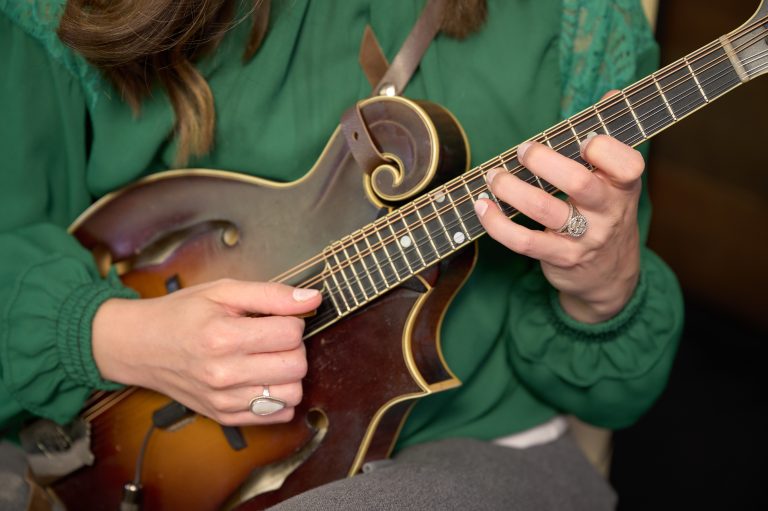
The mandolin is a soulful instrument that rewards precision and patience. However, if you’re not paying attention, bad habits can settle in quickly, hindering your progress for years. In this guide, we will explore the most common mandolin mistakes to avoid, ensuring your journey is built on a foundation of conservatory-level technique. Whether you are learning bluegrass with Sierra Hull, classical with Caterina Lichtenberg, or something in between with Mike Marshall, the path to mastery begins with mindful mechanics.
Table of Contents
- 1. Ignoring Posture and Ergonomics
- 2. Not Holding Your Pick Correctly
- 3. Using Poor Left Hand Technique
- 4. Using the Wrong Fingering Approach
- 5. Practicing Without a Plan
- Conclusion
1. Ignoring Posture and Ergonomics
One of the most overlooked mistakes isn’t even about playing notes. It’s about how you hold the instrument. Many beginners hunch over the mandolin to see the fretboard, which leads to neck strain and restricted breathing.
A common error is supporting the weight of the neck with your left hand. Your left hand should be free to glide across the fretboard, not occupied with holding the instrument up. Use a high-quality strap, even when sitting, to ensure the mandolin stays at a consistent 45-degree angle. This allows your thumb to rest lightly against the back of the neck, rather than “hooking” it in a way that creates tension.
2. Not Holding Your Pick Correctly
Understanding how to hold a mandolin pick is a vital foundational skill that affects everything from your initial downstrokes to advanced tremolo. While some beginners gravitate toward thin, flexible plectrums, world-class classical mandolinist Caterina Lichtenberg suggests opting for a thicker, slightly larger pick. A larger surface area provides a better feeling in the hand and prevents the bright, overly sparkly tone associated with thin plastic.
A common mandolin mistake to avoid is tucking the pick too far back into the crook of the index finger. When you bury the pick, you lose the ability to articulate notes and are forced to grip the pick with excessive force just to keep it from falling out. To find the perfect placement, Caterina recommends a simple exercise: touch your nose.
Observe where the tips of your thumb and index finger naturally meet when you touch your nose. That exact point of contact is where your pick should live. By holding the pick more toward the front of both fingers, you maintain the flexibility required for different dynamics.
For a deeper dive into these mechanics, check out our expert guide on pick techniques for perfect tone.
3. Poor Left Hand Technique
The mandolin’s short scale length requires a specific approach to the fretboard. A common mistake is using guitar-style fingering, where the fingers approach the frets at a perpendicular angle. On the mandolin, your mandolin left hand technique should be more reminiscent of a violinist’s approach.
Eliminating “Flying Fingers”
Watch a master like Sierra Hull, and you’ll notice her fingers stay remarkably close to the strings even when they aren’t fretting a note. Beginners can suffer from “flying fingers,” where the unused fingers lift 2-3 inches off the fretboard. This creates wasted motion and makes fast passages impossible. To correct this, practice slow scales while focusing on keeping your fingers hovering just millimeters above the strings.
The Thumb Position
Avoid the “death grip.” If your thumb is squeezed tight against the back of the neck, your fingers will lose their reach. Your thumb should be a mobile pivot point, not a vise. Keeping a “hole” or space between the crook of your thumb and the neck is vital for mobility.
4. Overcomplicating Your Fingering Approach
One of the most exciting things about the mandolin is how quickly you can start making real music. As Sierra Hull points out, in bluegrass and folk music there are literally hundreds of songs you can play with just three chords, and on the mandolin, those chords are surprisingly easy to learn. The mistake most beginners make is overcomplicating their fingering before they’ve even built a foundation.
Start with the Two-Finger G Chord
Sierra’s advice is to make the two-finger open G chord your home base. Because the mandolin has open G and D strings that are already part of the G Major scale, you only need two fingers to complete the chord: your index finger on the second fret of the A string, and your middle finger on the third fret of the E string. Strum all four string courses together and you have a full, resonant G chord. Sierra recommends returning to this chord whenever you feel lost.
“When in doubt, remember your two-finger G chord,” she says, because a lot of other things can be found from there.
Moving to C: Same Frets, Different Strings
Here’s where beginners often go wrong: they assume that moving to a new chord means learning an entirely new hand shape. With the mandolin’s tuning, that’s often not the case. To move from G to a two-finger open C chord, Sierra teaches that you simply keep your fingers on the same frets (second and third) but shift them up one set of strings, from the A and E strings to the D and A strings. That’s it. Same fingering, new chord.
One thing to be mindful of: with the C chord, you’ll want to lightly mute the open E string. Sierra notes that if your left hand has a natural bend to it and you’re not gripping the neck too tight, some muting is probably already happening naturally.
The D Chord: A Small Shift from G
For the two-finger open D chord, Sierra suggests starting from your G chord shape and making two small adjustments: drop the index finger entirely to let the A string ring open, then move the middle finger back one fret to the second fret of the E string, and bring the index finger up to the second fret of the G string. You now have an F# and an A fretting over open D and A strings, giving you a clean, full D chord.
The key takeaway is that G, C, and D are a family of chords that share fingering logic on the mandolin. Learning to move between them fluidly is the real goal. It will take time and your fingertips will get sore as you build calluses, but with time it gets easier.
If you’re struggling with transitions, Video Exchange Learning is a great resource. Submit a video of your chord changes and your instructor will review your technique and provide personal guidance to help you get there faster.
5. Practicing Without a Plan
The final “mistake” is an unstructured mandolin practice routine. Many students fall into the trap of playing what they already know rather than pushing into new territory. To see real growth, your practice should be divided into three distinct phases:
| Phase | Duration | Focus Areas |
|---|---|---|
| Warm-up | 10 Mins | Open string tremolo, slow scales, finger independence exercises. |
| Technical Study | 20 Mins | New chord shapes, arpeggios, or a specific Video Exchange lesson. |
| Repertoire | 20 Mins | Applying techniques to a song (e.g., “Soldier’s Joy” or a Bach Partita). |
Consistency is more valuable than intensity. Practicing for 30 minutes every day is significantly more effective than a single four-hour session once a week.
Conclusion
Identifying common mandolin mistakes to avoid is the first step toward becoming the musician you’ve always wanted to be. By refining your pick grip, mastering your left-hand technique, and committing to a disciplined routine, you bypass the frustration that causes many beginners to quit.
At ArtistWorks, you don’t have to learn in a vacuum. You get personal guidance from world-class masters. When you submit a video, your instructor will review your progress, catching those tiny errors in your fingering or posture before they become permanent habits. Ready to transform your playing?
Start a free trial at ArtistWorks and learn with personal guidance today.